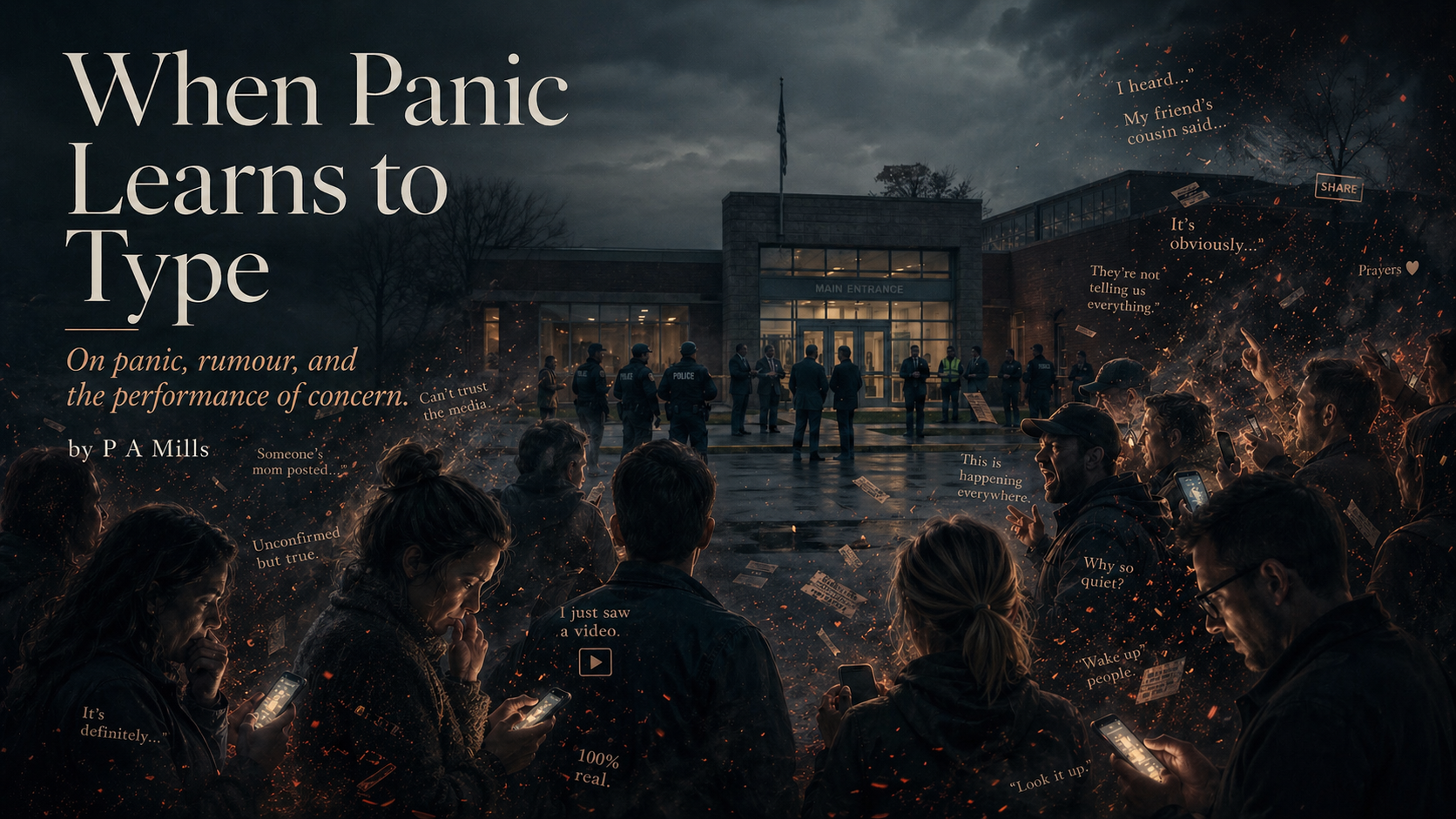
When Panic Learns To Type
There is a particular kind of public immaturity that only reveals itself when seriousness enters the room.
It mistakes agitation for intelligence.
It mistakes fear for evidence.
It mistakes the speed of its own reaction for moral importance.
And in situations where children’s safety is in question, that mindset is not merely foolish. It is dangerous.
When a school, the police, teachers, and local officials are dealing with an incident, the first duty of the wider public is not performance. It is discipline. Those involved professionally are working with procedure, training, safeguarding responsibilities, legal constraints, communication lines, and information the public usually does not yet have.
They do not have the luxury of turning uncertainty into theatre.
The public, unfortunately, often does.
A local page can call itself a community resource, but in the wrong hands it becomes a bonfire with a comment section. Fragments are thrown in. Fear is fanned. Half-formed nonsense is passed around as if being loudly frightened is the same thing as being useful.
It is not.
Emotionally charged nonsense is no basis for choices.
The World Health Organization warns that misinformation and disinformation can harm decision-making, health, security, and public trust. A 2018 MIT study, published in Science, found that false news online spreads “farther, faster, deeper, and more broadly than the truth”; crucially, the researchers found this was not simply a bot problem, but a human one. (World Health Organization)
That matters here.
Because the danger is not only false information.
It is the human appetite for it.
The immature mind cannot tolerate a gap. It cannot wait. It cannot endure uncertainty without trying to stuff something into the silence. So it reaches for rumour, tone, insinuation, second-hand whispers, emotional display, and the grim little pleasure of appearing informed before it has taken the trouble to know.
That is where facts go missing.
And once facts go missing, danger changes shape.
The original incident may be contained. The perimeter may be secure. The professionals may be doing exactly what they are trained to do. But outside that controlled space, another incident begins: panic spreading through parents, children, phones, homes, school gates, roads, and frightened minds already carrying enough.
This is how the crowd becomes a second hazard.
Not because fear is wrong. Fear is human. Any decent parent would feel dread in the stomach. Any sane person would understand the gravity of a threat near children.
But dread does not excuse recklessness.
Concern without restraint is not care. It is contamination. It burdens the very situation it claims to help. It unsettles families. It pressures staff. It gives children fragments of terror to carry home. It makes official communication harder to hear because the air has already been poisoned by speculation.
There is a difference between informing a community and inflaming one.
There is a difference between vigilance and hysteria.
There is a difference between public service and public self-indulgence.
A serious situation demands serious minds. Not comment-thread dramatists. Not amateur intelligence officers. Not people who confuse emotional activation with moral clarity.
If a page cannot hold the line between verified information and social combustion, it should not present itself as a public service. It is not helping the community. It is using the community’s fear as fuel.
In moments like this, the standard is simple: share only official updates, do not speculate, do not name children, do not amplify rumours, do not turn fear into entertainment, and do not mistake anxiety for knowledge.
Fear is understandable.
Feeding it is a choice.
And in a crisis, that choice can become another form of danger.
— P A Mills