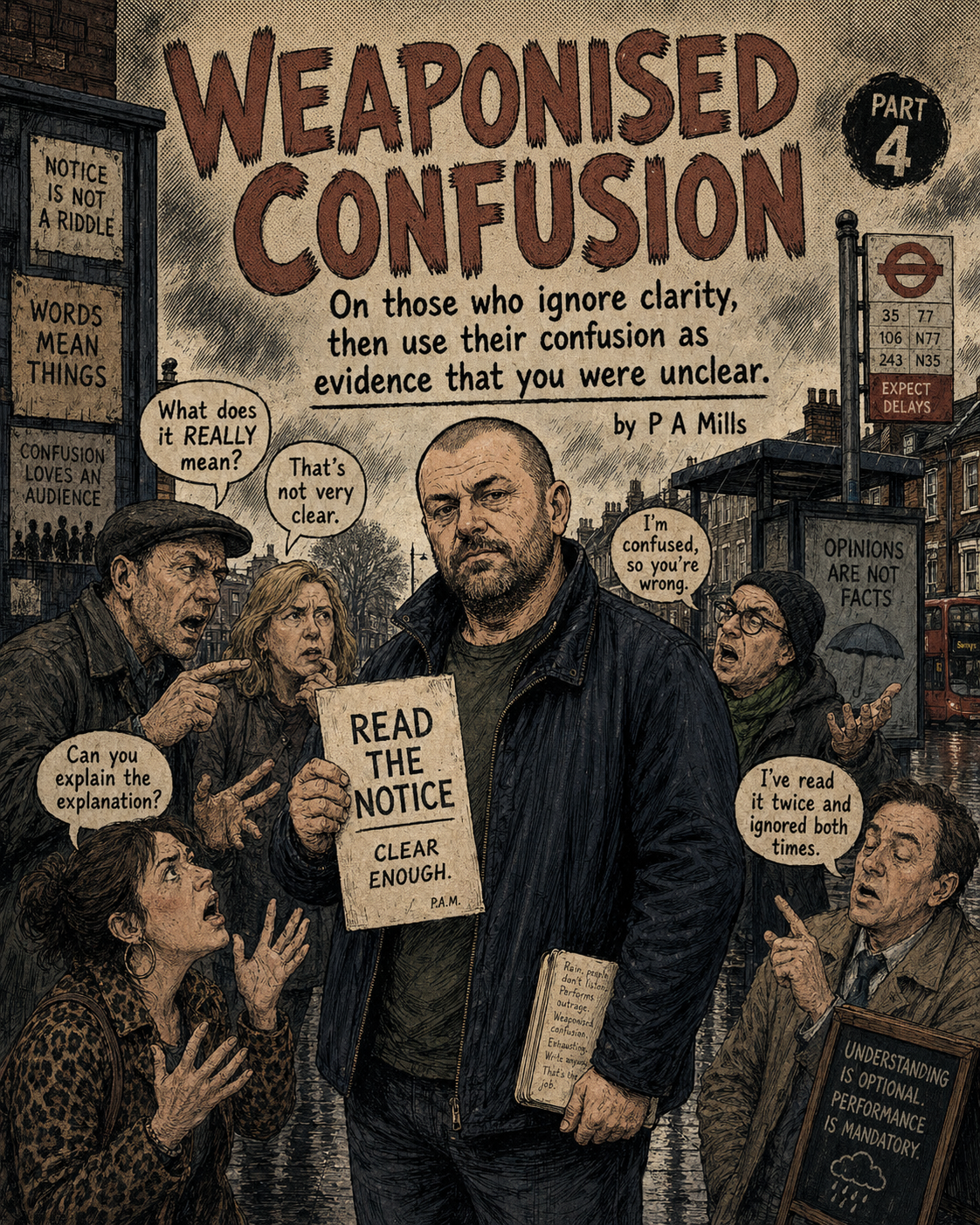
Weaponised Confusion
Weaponised Confusion
On those who ignore clarity, then use their confusion as evidence that you were unclear.
by P A Mills
A clear sentence should not need a barrister.
“See you tomorrow.”
Three words.
A small, ordinary sentence. Shoes on. Hair brushed. No obvious criminal record.
And yet, placed before the modern adult, it begins to acquire charges.
Tone.
Distance.
Pressure.
Ambiguity.
Possible emotional violence.
By lunchtime, the sentence has been remanded in custody.
This is the modern trick.
If a clear sentence is inconvenient, pretend it has become mysterious.
Not wrong.
Not cruel.
Mysterious.
As if language has suddenly grown antlers.
This is not stupidity.
Stupidity is cleaner than this. Stupidity walks into a glass door and learns, briefly, about glass.
Weaponised confusion sees the door, reads the sign, feels the handle, understands perfectly well that the door opens outward, then stands there asking what we mean by “open.”
That is not confusion.
That is refusal wearing a question mark.
The sentence was clear.
That was the problem.
Clarity removes hiding places. It does not arrive with velvet curtains, soft lighting, or a committee of emotional interpreters carrying biscuits. It simply stands there with meaning in its hands and expects an adult to meet it halfway.
Brave little sentence.
Poor doomed thing.
A normal person hears “See you tomorrow” and thinks:
Tomorrow.
Done.
But the professionally confused citizen is not built for done.
Done is dangerous.
Done means the sentence has completed its work.
Done means the listener now has responsibility.
So the face begins.
The eyes narrow.
The head tilts.
The little wounded inhale appears.
Then the voice.
“What do you mean by tomorrow?”
And there it is.
The first trumpet of collapse.
Within seconds, tomorrow is no longer tomorrow.
Tomorrow is tone.
Tomorrow is pressure.
Tomorrow is avoidance.
Tomorrow is a boundary issue.
Tomorrow is a passive-aggressive weather system with unresolved attachment problems.
The words remained still.
The adult began moving.
That is the trick.
Language becomes fog, then the speaker is blamed for the weather.
Somewhere, in the damp civic imagination, there is a building for this.
The Royal Institute for Not Getting the Point.
Cold stone.
Rain in the gutters.
A bus outside marked:
NOWHERE, BUT WITH FEELINGS
Inside, a receptionist sits beneath a brass sign:
RECEPTION OF NON-UNDERSTANDING
You say, “See you tomorrow.”
She looks over her glasses as if you have placed a dead fox on her desk.
“I’m sorry,” she says. “That was far too clear.”
A bell rings.
A file is opened.
By ten past nine, your sentence is marked POSSIBLE INCIDENT.
By half past nine, the file has stairs.
By ten, it has a department.
By lunch, three ordinary words have become a public inquiry with biscuits.
Upstairs, the clerks begin.
Clear Boundary: HOSTILE
Plain Instruction: UNCLEAR
Direct Message: TONE ISSUE
Simple Request: AGGRESSIVE
Ordinary Sentence: NEEDS MORE WORK FROM YOU
A plain sentence goes in.
A grievance comes out.
That is the machine.
No gears.
No steam.
Just adults with pens and the moral courage of wet cardboard.
Then come the specialists.
The Selective Reader, who reads every third word and resents the other two.
The Tone Analyst, who can find violence in a full stop.
The Emotional Archaeologist, who digs for hidden meaning in soil he brought from home.
The Concern Consultant, arriving with tea, sorrow, and a face that says the room should apologise to her childhood.
“I just feel there are deeper issues,” she says.
Of course she does.
There are always deeper issues when the surface is too clear to argue with.
And still the sentence waits.
See you tomorrow.
Still there.
Still calm.
Still wearing its little shoes.
But now it has been accused of distance, strategy, coldness, excessive brevity, lack of warmth, and possible contempt.
So the Tribunal of Hurt Feelings opens.
Everyone rises.
Mainly because the chairs are uncomfortable.
The judge adjusts his wig.
Peers at the evidence.
“See you tomorrow,” he reads.
A gasp in the gallery.
One woman grips her pearls.
A man whispers, “God help us.”
The judge leans forward.
“This is not merely a statement.”
No.
Of course not.
Nothing is merely anything anymore.
“This is a phrase dense with implication.”
The clerk writes that down.
Badly.
A second judge speaks.
“Could tomorrow be a threat?”
A third raises a finger.
“Could see imply surveillance?”
The court murmurs.
Someone faints into a tote bag.
A note is passed to the bench:
SOUP ANGLE TO BE EXPLORED
This is how civilisation dies now.
Not with a bang.
Not with a whimper.
But with a grown adult asking whether “see” has been used in a controlling way.
And the filthy little truth is this:
They know.
They understood.
The meaning got in.
They simply did not enjoy its arrival.
So now the meaning must be punished.
Dragged through tone.
Dragged through motive.
Dragged through the soft municipal hell of “how it came across.”
Tone is the sanctuary of people who have lost the argument but still want to feel injured.
Tone matters, yes. One can say a true thing like a bastard. One can hide a knife in “fine.” We know this.
But tone is also where cowards go when the meaning has them cornered.
They cannot say the sentence was false.
They cannot say it was unclear.
They cannot say they were not told.
So they say it had a tone.
Which tone?
The tone tone.
The bad one.
The one that lets them escape the point wearing a little victim hat.
The weaponised confuser does not say:
“I understood you, and I resent being expected to change.”
Too clean.
Too honest.
Too adult.
They say:
“I’m struggling with how this was communicated.”
Translation:
The meaning survived, and I would like compensation.
Children do this better.
A child says, “I don’t want to.”
Fine.
Useful.
Plain.
The adult says, “I’m not sure the expectations were held in a way that felt accessible to me.”
Same thing.
Now with a lanyard.
This is the destruction of adult supremacy.
Some adults are not wiser than children.
They are only better at putting refusal through administration.
Selfishness becomes process.
Avoidance becomes sensitivity.
Cowardice becomes confusion.
Have a biscuit.
Then grow up.
Because understanding requires humility.
That is the part they cannot bear.
To understand another person properly is to risk being changed by them.
You might have to adjust.
Apologise.
Stop doing the thing.
Accept that your first reaction was not the voice of God, but your ego coughing into a paper bag.
Terrible.
Awful.
Nearly fatal.
So the coward chooses fog.
Fog keeps the confused person central. The moment someone says, “I don’t understand,” the room turns.
Now the clear sentence must explain itself.
Then explain the explanation.
Then apologise for the explanation’s emotional posture.
Then produce diagrams.
Then attend a meeting.
This is how weaponised confusion wins.
Not by being right.
By making clarity do paperwork.
No.
At some point, the sentence has done its job.
At some point, the listener must arrive.
Not every failure to understand belongs to the speaker.
Not every discomfort is evidence of harm.
Not every plain statement requires a support animal and a subcommittee.
Sometimes the words were fine.
Sometimes the meaning was obvious.
Sometimes the problem is that an adult has discovered confusion gives them power.
That is where the joke stops smiling.
Because this is not harmless.
It punishes honesty.
It makes sincerity expensive.
It teaches people to dress every sentence like a hostage negotiator.
Eventually nobody says what they mean.
Everything arrives padded.
Softened.
Pre-apologised.
Bubble-wrapped.
And still someone rises from the mist asking what the bubble wrap “really means.”
This is not sensitivity.
It is theatre for the emotionally evasive.
The truth is simpler.
Understanding requires humility.
Fake confusion preserves vanity.
That is the engine.
The rest is smoke, stationery, and adults pretending the door has become metaphysical.
And somewhere beneath the forms, the stamps, the tone reports, the emotional archaeology, and the Tribunal of Hurt Feelings, the original sentence remains.
Still there.
Still clear.
Still unimpressed.
Waiting.
Not to be explained again.
Not to be softened.
Not to be dragged through another room full of adult children with clipboards.
Waiting for one honest thing.
A person with enough courage to understand it.
Because it was never unclear.
They were never confused.
They were hiding