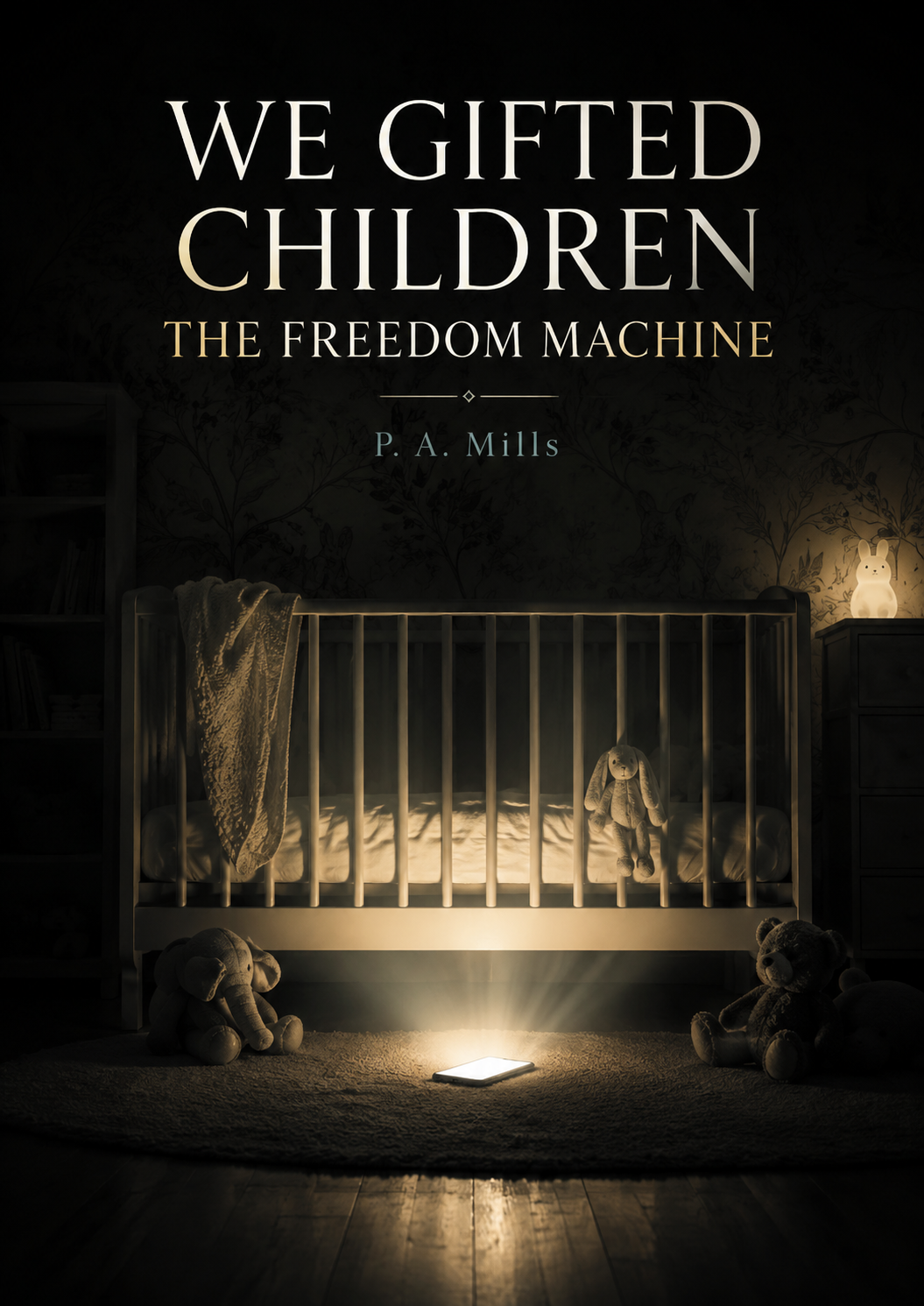
We Gifted Children The Freedom Machine
What did you think would happen when you placed the universe in the hands of children?
That is the question nobody wants to ask, because the answer is too humiliating.
We gave them everything.
Pornography. War. Suicide. Celebrity. Gambling. Humiliation. Beauty panic. Political madness. Strangers. Predators. Billionaires. Filters. Fame. Shame. The collected stupidity of the human species, glowing in the palm of one unfinished mind.
Then we called it freedom.
It was not freedom.
It was exposure.
Freedom requires maturity, privacy, silence, boundaries, and the right to make mistakes without the whole village watching. What we gave children was not a wider world. It was a collapsing one.
No walls.
No dusk.
No locked door.
No final bell.
The old childhood had dangers. Of course it did. Let us not pretend the past was all conkers, fields, jam sandwiches and morally upright fathers reading newspapers.
But the old bully had to find you.
Now he lives in your pocket.
The old shame faded by Monday.
Now it has screenshots.
The old gossip died in the street.
Now it has servers.
And still we act surprised.
We built a machine designed to defeat attention, then complained children cannot concentrate. We built a machine designed to provoke envy, then complained children are anxious. We built a machine designed to reward performance, then complained children are false. We built a machine designed to murder boredom, then complained children have no imagination.
This is not a crisis of childhood.
It is a confession by adults.
We live in a world where grown performers roll around on stages in baby-doll costumes while other grown adults applaud the liberation of it all from seats they paid three hundred pounds to occupy. Then these same adults go home and wonder who sexualised the children.
We did.
We handed the nursery to the marketplace, then congratulated ourselves on being modern.
With the erosion of childhood standards came something worse: the erosion of reality itself.
For example: what does reality dating culture teach anybody about love?
Nothing.
It teaches heat. Display. Ranking. Selection. Replacement. It teaches that intimacy is a transaction under lighting, that bodies are auditions, that jealousy is romance, that desire is proof, and that “love” can arrive on Tuesday, collapse by Thursday, and be replaced before the next advert break.
That is not love.
That is appetite with a production budget.
But adults watch it. Adults laugh at it. Adults post about it. Then the children in the room, on the stairs, upstairs later with the clips and feeds, absorb the lesson.
And we wonder why young men have warped ideas about sex. Why romance arrives as entitlement. Why rejection is treated as insult. Why the opening move is a photograph of a penis before a sentence.
Love is not access.
Love is not conquest wearing aftershave.
Love is not “you did not let me have you on night one, therefore I withdraw my worship.”
Love is the harder question:
Would you suffer for this person?
Would you stay?
Would you protect?
Would you lose sleep, pride, comfort, vanity, appetite, even life itself, because their existence means more than your wanting?
That is love.
Not a villa.
Not a filter.
Not another little boy with a phone in his hand mistaking erection for destiny.
When social media and the mobile phone arrived as one bright, intimate force, humanity was too dazzled to separate the gift from the infection. We saw connection, speed, knowledge, novelty. We did not see dependency, surveillance, the corrosion of patience, the flattening of thought.
As adult use rose, adult judgement fell.
Decency thinned.
Courage softened.
Intelligence became reactive.
We were so busy staring into the new light that we took our eyes off the generation coming behind us.
And because we did not understand the machine ourselves, we passed on no wisdom. No etiquette. No restraint. No moral grammar. No serious warning about what this thing could do to attention, sex, friendship, privacy, truth, shame and love.
The tech companies built the cage.
The media companies decorated it.
Both now speak of connection, entertainment and choice because “we monetised the soft tissue of adolescence” does not test well with shareholders.
Politicians speak of safety because safety sounds better than “we noticed too late.”
Parents speak of screen time because “I am fighting a trillion-dollar addiction laboratory from my kitchen” sounds too close to despair.
And children, as usual, get the blame.
They are addicted, we say.
Yes. To a product designed to addict them. Brilliant detective work.
They are vain, we say.
After we taught them that the face is currency.
They are distracted, we say.
After we placed a casino, brothel, riot, shopping centre, schoolyard and propaganda office inside their bedroom.
What exactly did we expect?
A generation of miniature philosophers?
Sixteen-year-old Marcus Aureliuses scrolling past self-harm content and lip fillers with calm Roman detachment?
Please.
A child cannot consent to being engineered.
That should be law, principle and instinct. Instead we turned childhood into a market and called concern hysteria.
A child does not experience the algorithm as liberty. A child experiences it as weather. It surrounds them. Presses on them. Tells them who is beautiful, who is worthless, who is laughing, who has been invited, who is desirable, who is invisible.
And because children are not finished, they believe the weather is the world.
That is the obscenity.
Not technology. Not knowledge. Not the internet itself. The internet contains brilliance: books, music, art, comedy, history, friendship, discovery, rescue.
The obscenity is machinery built around compulsion and sold as liberation.
We did not give them the library of Alexandria.
We gave them a fruit machine with pornography and homework tabs.
Now comes the adult theatre.
A ban alone is theatre. No ban at all is surrender.
Parents cannot out-parent an algorithm. Teachers cannot out-teach a machine designed to break attention. Children cannot self-regulate against systems built by adults to defeat self-regulation.
Stop pretending settings menus are ethics.
Stop calling captivity engagement.
Stop blaming children for being damaged by the world adults placed in their hands.
This is mass self-harm at civilisational scale.
Not because robots conquered us.
Because we surrendered voluntarily.
We bought the devices. We charged them. We wrapped them for birthdays. We placed mind-muddling machines into the hands of eight-year-olds and called it normal.
Now we talk about legislation as if law alone can put the river back in the mountain.
It cannot.
The systems will adapt. The platforms will adapt. The users will adapt. The devotees will find the side door, the fake age, the borrowed account, the darker app, the next glittering little trap.
But teaching is not useless.
Teach the machine.
Teach the trick.
Teach the child where the hook is buried.
Teach it at curriculum level: attention, consent, privacy, pornography, algorithms, envy, shame, love, truth. Teach children how they are being manipulated before the manipulation becomes their personality.
And let us not comfort ourselves with robot mythology.
Artificial intelligence did not creep into the nursery at midnight and lay a phone beside the child.
We did.
We did it because it was convenient.
Because it was dazzling.
Because everyone else was doing it.
And now, having fed our own blood into the machine, we have the nerve to call the damage mysterious.
It may already be too late to stop it.
It is certainly too late to pretend we did not know.
We gifted them the freedom machine.
Then we watched them become anxious, lonely, distracted, sexualised, cruel, frightened and permanently observed.
And still some clever little man in a good suit will tell us this is about liberty.
No.
It is about adults who sold childhood to the machine, then asked why the children came back changed.