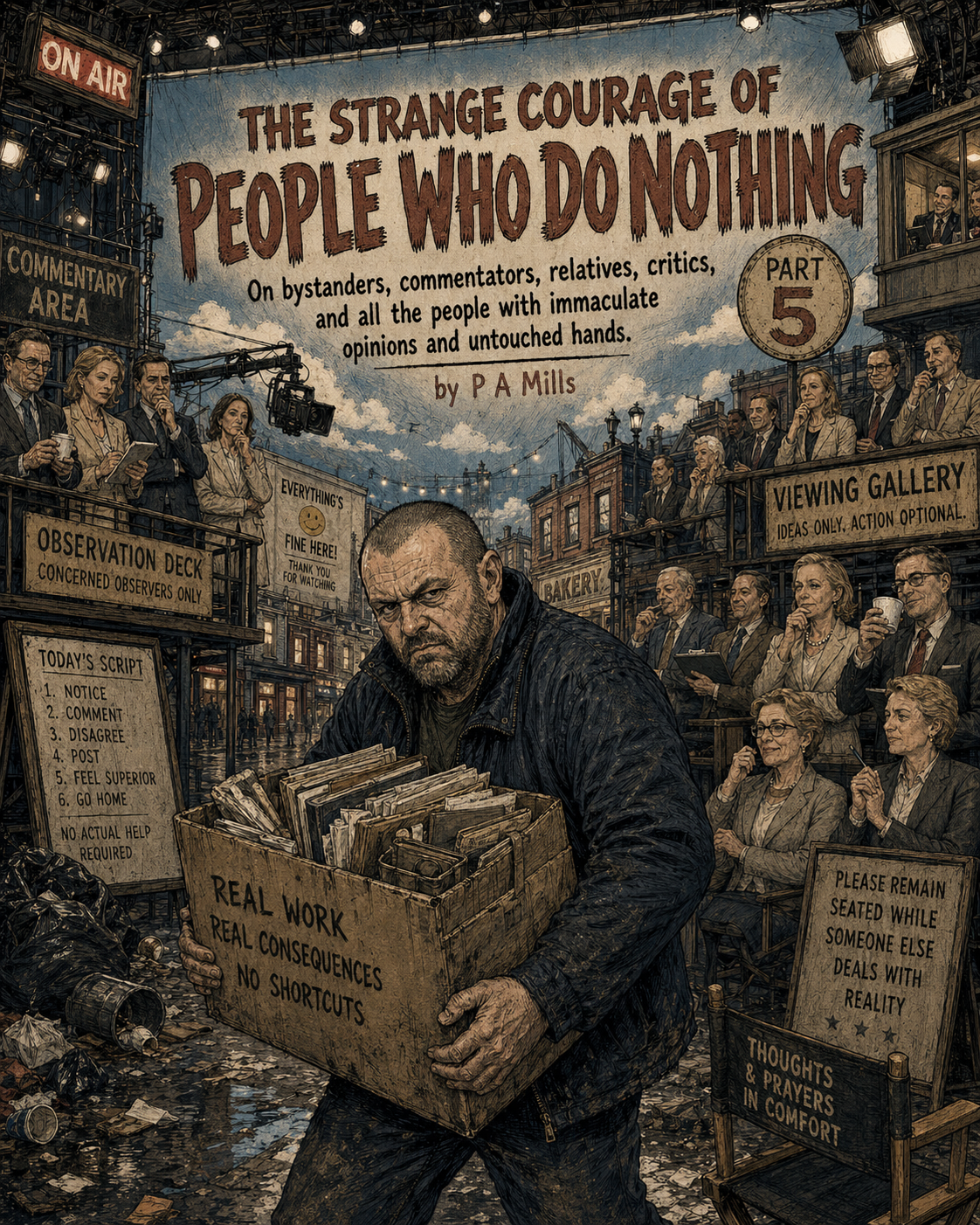
The Strange Courage Of People That Do Nothing
On bystanders, commentators, relatives, critics, and all the people with immaculate opinions and untouched hands.
by P A Mills
There is a particular courage found only in people who were never in danger.
It arrives late.
Always late.
After the decision has been made.
After the work has started.
After somebody else has stood inside the heat and come out smelling of smoke.
Then, from somewhere clean and safe, a voice appears.
“Well, what I would have done is…”
Beautiful.
The national anthem of the unused hand.
A phrase spoken most confidently by people who, at the decisive moment, did precisely nothing.
Not a little.
Not quietly.
Nothing.
They watched.
They waited.
They preserved themselves in the protective oil of non-involvement.
Then, once the moment had become safe enough to narrate, they emerged with a full ethical framework and the expression of a disappointed magistrate.
You have to admire the timing.
Not the bravery.
There is none.
But the timing is exquisite.
These people are everywhere.
In families.
In workplaces.
In comment sections.
Around illness.
Around grief.
Around conflict.
Around any human situation where someone has had to act without the luxury of perfect information.
They do not enter the burden.
They orbit it.
Close enough to judge.
Far enough not to bruise.
And from that safe little orbit, they become magnificent.
Wise.
Balanced.
Measured.
Concerned.
They can see all sides, mainly because they are standing on none of them.
This is often mistaken for perspective.
Sometimes it is.
Often it is cowardice with a better view.
The person acting is always compromised. That is the curse of action. To act is to become visible. To choose is to exclude. To speak is to risk being misunderstood. To protect is to be accused of control. To help is to risk helping badly.
Action leaves fingerprints.
Inaction wears gloves.
That is why the do-nothing critic always looks so clean.
Of course their opinion is immaculate.
It has never touched reality.
The moment a person acts, they enter the evidence. Their words can be quoted. Their choices can be inspected. Their timing can be questioned. Their tone can be weighed by people who were not there, did not help, and somehow still found the strength to be disappointed.
A heroic species.
The commentator.
The relative.
The bystander.
The concerned observer.
The critic in the warm chair.
The person who says, “I didn’t want to get involved,” and then gets involved exclusively through judgement, which is the safest and most luxurious form of involvement.
They are not silent.
That would be useful.
They are not helpful.
That would involve movement.
They are available for remarks.
Remarks are their natural habitat.
“I just think it could have been handled better.”
Of course you do.
Everything can be handled better from a distance.
A fire looks very manageable from the pavement opposite.
The chair is important.
Without the chair, their philosophy collapses.
So they sit.
And from the chair comes wisdom.
“What I would have done…”
No, you wouldn’t.
That is the point.
You would have done what you did.
Nothing.
You would have stayed where you were, keeping yourself clean for the trial afterwards.
But later, when the danger had passed and the person who acted was tired enough to look human, then you would have been magnificent.
A lion.
In retrospect.
They arrive after the damage with perfect grammar and no fingerprints.
They have notes.
“You seemed angry.”
“That message was a bit much.”
“Everyone needs to take responsibility.”
Everyone.
A marvellous word.
The coward’s blanket.
Throw “everyone” over a situation and suddenly nobody in particular has to bleed.
But there is usually one person who carried, one person who answered the phone, opened the door, signed the form, held the line, took the blame, or cleaned up the mess.
And then there is everyone else.
Everyone else is very strong on reflection.
Reflection is lovely when there is no mop involved.
Doing nothing may sometimes be wise. Restraint exists. Silence can be honourable. Not every crisis requires another amateur hero wandering in with a torch and a theory.
But doing nothing and then claiming moral authority over those who did something is a different creature entirely.
That is not restraint.
That is theft.
It steals the authority of the burden without carrying the burden.
It wants the right to judge the wound without having touched the blood.
It wants the nobility of concern without the embarrassment of usefulness.
There is a lie these people tell themselves.
They call it neutrality.
“I’m not taking sides.”
Very good.
A statesman.
A philosopher.
A traffic cone with opinions.
But not taking sides is not always moral depth. Sometimes it is simply a refusal to stand where standing costs something.
They are not above the situation.
They are outside it.
There is a difference.
Above implies perspective.
Outside often means they found the exit early and kept the coat.
Then they watch those still inside with puzzled superiority.
Why are they so emotional?
Why are they so tired?
Why are they not handling this more gracefully?
A fair question, if asked by a statue.
People inside the burden do not always look elegant. Reality ruins posture. It makes the voice shake. It makes the face hard. It takes all the theory you had about yourself and throws it into a room with fear, pressure, other people, and a broken kettle.
Nobody looks their best carrying weight.
That is why weight is heavy.
The clean-handed critic looks better because they are not carrying it.
And somehow this becomes evidence against the carrier.
Look at them.
Angry.
Tired.
Sharp.
Changed.
Yes.
That can happen when a person does the thing you avoided.
The bystander’s great talent is arriving clean to the trial of the dirty.
They sit there with untouched hands folded neatly, listening to accounts of panic, exhaustion, compromise, fear, and grief, then pronounce on the emotional tone of those who were actually present.
A remarkable performance.
Like a man reviewing a shipwreck from a deckchair.
“Personally, I would have swum with more dignity.”
Would you?
Would you, though?
Or would you have done what you did when the sea came in?
Protected your shoes.
The comedy would be harmless if the damage were not real. Clean-handed judgement corrodes people. It teaches those who act that being useful is dangerous, while being absent has excellent public relations.
That is a sick lesson.
The exhausted carry.
The immaculate comment.
That is the arrangement.
The final insult is that these people often think they are kind.
Only concerned.
Only worried.
Only saying.
Only observing.
Only trying to be fair.
Fairness, in their mouth, often means the careful redistribution of discomfort away from themselves.
They want peace without courage.
Clarity without conflict.
Family without loyalty.
Community without labour.
Opinion without service.
They want the moral authority of involvement without the inconvenience of being useful.
No.
At some point, a civilisation has to learn the difference between witness and parasite.
A witness sees and accepts responsibility for what they have seen.
A parasite sees and feeds.
The person who acted may have acted imperfectly.
Of course they did.
They were human, under pressure, inside time.
The person who did nothing is not superior because they made no mistake.
They simply made no mark.
Clean hands are not proof of innocence.
Sometimes they are only proof of absence.