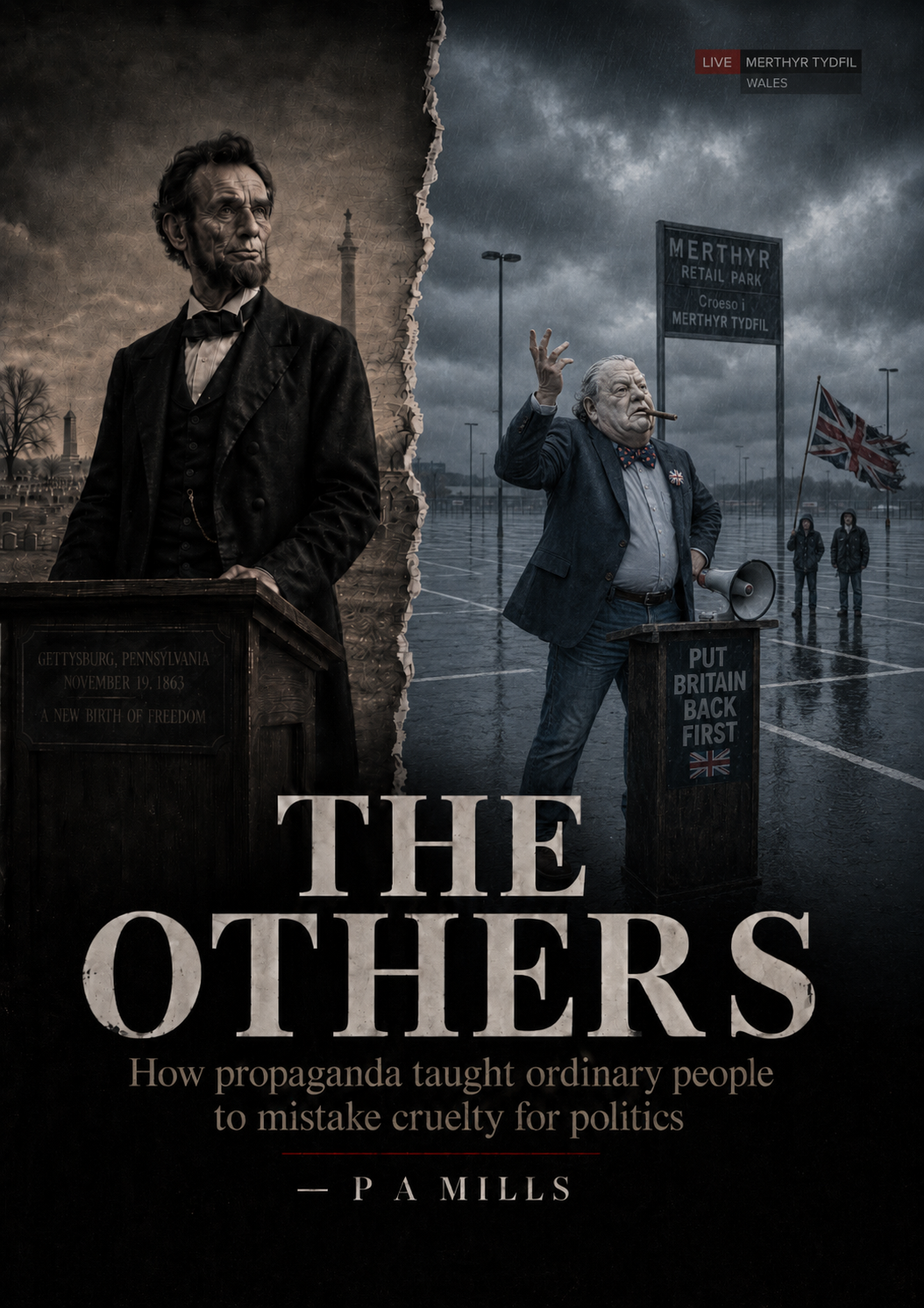
The Others
How propaganda taught ordinary people to mistake cruelty for politics
— P A Mills
There is a point in a poisoned conversation where politics disappears.
It does not arrive with a speech. It does not announce itself with a flag, a black shirt, a boot, or some theatrical villain leaning over a map. It comes quietly. Almost casually. A phrase dropped into ordinary talk.
“The others.”
That is where the rot shows.
Not in disagreement. Disagreement is necessary. Not in concern about immigration. Concern is legitimate. Not in wanting borders, laws, checks, numbers, limits, order. Any serious country requires those things. A nation without rules is not compassionate. It is merely badly run.
But “the others” is not policy.
“The others” is sorting.
It is the little gate in the mind where human beings stop being people and become a category. Then a pressure. Then a threat. Then a pest. Then something to be removed.
That is what the modern fear machine has done. It has not only misinformed people. It has trained them to speak differently. It has given them a new grammar. Not the grammar of politics, but the grammar of suspicion. The ones. The others. The problem. Illegal aliens. Rats. Invaders. Our way of life. Get them gone.
Rolling news helped build the room.
Twenty-four-hour news did something strange to politics. It removed the pause. There was no longer a morning paper, an evening bulletin, a day to think, a night for the dust to settle. There was the same event stretched until it became weather.
Breaking news. Developing story. Urgent update. Live reaction. Expert panel. Counter-panel. Man in studio pretending not to enjoy the fire.
A serious issue could no longer simply exist. It had to escalate.
Immigration became crisis. Crime became collapse. Protest became chaos. A dinghy became an invasion fleet. A policy disagreement became a war for the soul of the nation before anyone had finished their tea.
Then social media did the rest.
The rolling news channel lit the room.
The algorithm locked the door.
That is why people now speak in headlines. They do not say, “I have concerns about asylum processing, housing capacity, wage pressure, integration and border enforcement.” They say, “Country’s gone.” They say, “Rats.” They say, “The others.” They say, “Look it up,” meaning: I have absorbed the mood and mistaken it for evidence.
The old news cycle informed people badly.
The new one agitates them constantly.
Then, when challenged, the whole thing hides behind the oldest coward’s curtain in the room.
“It’s just my opinion.”
No. It is not always just an opinion.
Sometimes it is a slogan you borrowed from people who would not open their own gates to you either. Sometimes it is a headline wearing your mouth. Sometimes it is a frightened little sentence dressed up as national courage.
And this is where the damage shows.
Not on the news, where it can still pretend to be debate. Not in Parliament, where suits and slogans give ugliness a bit of polish. It shows in your rugby club. In your local bar. In the smoking area beneath a cracked heater. In the back room after darts. At the table after three pints, where somebody says something vile and everyone decides whether to laugh, challenge it, look at the floor, or call it banter.
That is where propaganda succeeds.
Not when people merely hear it.
When they repeat it socially and suffer no shame.
The broadcast comes out of a familiar mouth. Someone’s uncle. Brother. Cousin. Team-mate. Bloke from the club. Man at the bar who knows everything after lager but could not explain the council budget with a gun to his head.
Then drink gets blamed, because drink is the oldest hired solicitor in Britain.
“He was drunk.”
As if drunk invented him.
It did not.
Drink does not put a politics in a man. It opens the cupboard where he keeps it.
The pint did not create the word “rats.” The whisky did not invent “shoot them.” The lager did not teach him “the others.” It only gave the sentence permission to come out wearing no trousers.
That is why the local bar matters. That is why the rugby club matters. That is why the family chat matters. Because the national sickness does not stay national. It becomes domestic. It gets into ordinary rooms. It sits beside birthday messages, emojis, jokes, weather complaints, funeral notices and gossip about who has gone strange.
And suddenly, the language of pest control appears.
Immigration is a serious subject. That is precisely why it should not be left to men who have mistaken disgust for thought.
The numbers matter.
Net migration to the UK was 204,000 in the year ending June 2025, around two-thirds lower than the previous year’s 649,000. That does two useful things at once. It proves the public did not imagine recent scale, and it proves the panic merchants are still selling the peak as if it were permanent weather.
Asylum is real too. In the year ending December 2025, 100,625 people claimed asylum in the UK, slightly lower than the year before but still more than twice the level in 2019. That is not nothing. That is backlog, housing, legal process, public confidence and international duty colliding in one ugly room.
Small boats are real. The Home Office recorded 43,309 people arriving by small boat in the year ending June 2025. That is a serious failure of border management and international cooperation. It is also a human disaster, because the Channel is not a policy seminar. It is cold water.
And yes, the demographic claims get twisted by both sides. Around 76% of people arriving by small boat in 2025 were adult men, 12% were adult women, and 12% were children. So no, it is not “mostly women and children.” But it is also not “only fighting-age men,” whatever that grubby little phrase is meant to imply. The truth is not kind enough for one side or nasty enough for the other.
That is the trouble with truth.
It keeps refusing employment by cowards.
The right lies by turning complexity into invasion. The left sometimes lies by turning pressure into compassion theatre. One says every migrant is a threat. The other sometimes speaks as though borders are a moral embarrassment and anyone who worries about scale has failed some private decency exam.
Both are evasions.
The economic argument is not clean either. In the year ending June 2025, 69% of non-EU immigration was for work and study purposes. That does not fit the “everyone is coming for benefits” line. But the labour-market evidence is also not a slogan for open-hearted idiots: overall effects on UK-born workers’ wages and employment are generally small, while low-wage workers are more likely to lose out and medium or higher-paid workers are more likely to gain. Pressure does not land evenly. It usually lands first on people with the least insulation.
The fiscal argument is muddy too. Migration’s effect on public finances depends on age, skills, earnings, route, family size and length of stay. Some groups contribute strongly. Others cost more. Anyone pretending there is one magical answer is selling you a badge, not an argument.
So say the honest thing.
Say immigration must be controlled, lawful, serious and honest.
Say working-class areas need investment before, during and after population change.
Say councils need money.
Say housing cannot be treated as an investment game and then blamed on foreigners.
Say employers should not be allowed to use migrant labour as a wage-control device.
Say integration matters.
Say English matters.
Say women’s safety matters.
Say religious extremism matters.
Say asylum backlogs matter.
Say illegal routes matter.
Say the public has been lied to.
Say all of it.
But do not say “rats.”
Because the moment you need vermin language to hold your argument together, your argument is already dead.
Not open borders.
Not closed hearts.
A serious society controls its borders without surrendering its soul.
This should not be difficult, but apparently adulthood has been discontinued.
We now live in a country where half the public conversation is conducted by people who have read one headline, watched three videos, misunderstood four numbers, and now believe the problem is human rights.
They say “look it up” with the confidence of men who have never looked anything up beyond the thing that confirmed what they already felt.
“Look it up” has become the mating call of the badly informed.
Nobody says, “I looked it up and I may have been wrong.”
Nobody says, “The number is real, but my conclusion was filthy.”
Nobody says, “I have confused border control with the pleasure of imagining removal.”
No. They say “rats.” They say “aliens.” They say “the others.” They say “get them gone.” Then they complain that nobody wants a reasonable debate.
Reasonable debate?
You cannot arrive at a reasonable debate carrying a bucket of petrol and crying about censorship because someone noticed the match.
A society for all is not a slogan for mugs. It is the only civilisation worth defending.
That means every faith and no faith. Every colour. Every sex. Every class. Gay, straight, trans, disabled, autistic, born here, newly arrived, polished, rough, fluent, struggling, certain, frightened, useful, difficult.
All of them.
Not because everyone is good.
Because a society that begins by deciding which groups can be spoken of as dirt has already lost the thing it claims to protect.
You want national pride?
Start there.
Do not wave a flag over moral sewage and call it patriotism.
A flag is not a towel for wiping your conscience.
And spare me the sudden concern for women, gay people, Jewish people, children, workers, and “our way of life” when it only appears as a stick to beat Muslims, refugees, or migrants with.
If you care about women, care about women when the threat is domestic, wealthy, respectable, drunk, uniformed, elected, married, or sitting at the end of your own table.
If you care about gay people, care about them when they are not useful in an argument about Islam.
If you care about workers, ask why wages have been crushed while landlords, shareholders and private contractors somehow never seem to be “the problem.”
The billionaire press does not love the working class.
It studies them.
It learns what frightens them, what flatters them, what makes them angry, then sells the same wound back to them with adverts between the paragraphs.
Fear makes people consume.
Fear sells newspapers. Fear wins elections. Fear fills comment sections. Fear gives stupid men the sensation of depth. Fear lets a person who cannot explain the housing market believe he has solved Britain because he can point at a dinghy.
There is another lie in this national performance. The idea that cruelty is courage.
It is not.
Cruelty is easy. Any idiot can be cruel. Any frightened man can dress up panic as realism. Any pub philosopher with a phone can say the hard thing if the hard thing is just an ugly thing said loudly.
Real courage is harder.
Can you defend border control without hating the desperate?
Can you defend compassion without lying about numbers?
Can you defend women’s rights without turning all Muslim men into one dark shape?
Can you defend workers without pretending every migrant is the reason Britain is broken?
Can you criticise culture without becoming a bigot?
Can you love your country without needing someone else to be less human?
Can you sit in your rugby club, your local bar, your family kitchen, your workplace, your group chat, and say no when the room wants you to laugh?
That is the test.
Not your vote.
Not your party.
Not your flag.
Your conscience.
Forget the world for a moment. Forget the party. Forget the newspaper. Forget the rolling panel of professional alarm. Forget the bloke at work. Forget the algorithm that has learned your anger better than your mother ever did.
Can you answer to your own conscience?
Not your tribe. Not your feed. Not the flag in your profile. Not the little audience that rewards you for sounding harder than you are.
Your conscience.
That old inconvenient thing.
The private court.
The one you cannot impress with memes.
Because if your politics only works after you have turned people into “the others,” it is not politics.
It is permission.
To stop thinking.
To stop seeing.
To enjoy the language of disposal while pretending you are defending civilisation.
That is the final obscenity. These people think they are protecting Britain. They are not. They are helping reduce it to a frightened little sorting office with flags in the window and sewage in the soul.
Britain does not need more people shouting “our way of life” while forgetting what any decent way of life requires.
Law, yes.
Borders, yes.
Honesty, yes.
But also restraint.
Mercy.
Proportion.
Memory.
The ability to look at another human being and not immediately ask whether they belong to “us” or “them.”
That is not weakness.
That is civilisation.
And if civilisation is too soft a word now, if mercy sounds wet, if conscience sounds woke, if human dignity sounds like something only fools believe in, then at least have the guts to say what has really happened.
You have not become brave.
You have been trained.
You have been fed fear until it came out of your mouth as certainty.
You have mistaken propaganda for instinct.
You have mistaken cruelty for patriotism.
You have mistaken “the others” for an argument.
And somewhere, in an ordinary room, in an ordinary conversation, among kisses, emojis, jokes, pints, club ties, bar stools, rolling news straps, expert panels, live updates and people trying to keep the peace, the language of national collapse has learned to sound normal.
That is how politics dies.
Not when people disagree.
When they forget they are talking about people