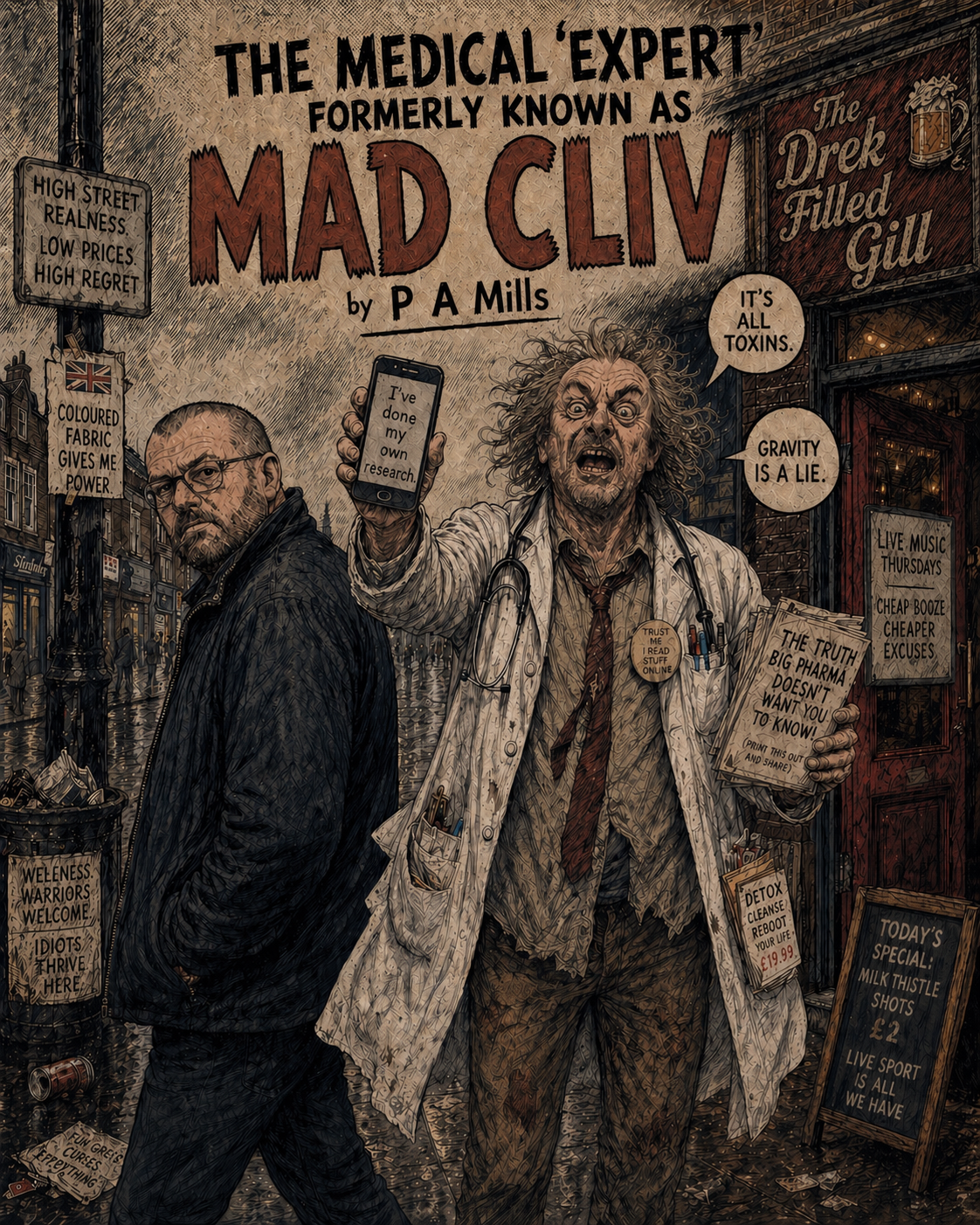
The Medical ‘Expert’ Formerly Known As Mad Clive
A study of the man who, after one search, two anecdotes, and a video from another man in sunglasses, becomes ready to challenge modern science from the comfort of a sofa.
by P A Mills
There was a time, perhaps imaginary, when serious matters imposed a limit on the mouth.
Not silence, exactly.
Silence would be asking too much of the human race, and one must not set impossible targets before breakfast.
But there was, at least, a small delay.
A pause.
A modest interval between knowing absolutely nothing and beginning to advise everyone.
One heard words like treatment, results, consultant, specialist, and some ancient mechanism in the civilised mind would whisper: Careful now. This may not be your field.
A beautiful idea.
Almost antique.
Like table manners, joined-up handwriting, or the belief that reading a leaflet made one informed rather than medically ordained.
Of course, there was always a man at the edge of any serious situation saying, “I’ve got a theory.”
If a volcano erupted in the high street, some fellow in a fleece would immediately explain that the council had known for weeks.
But once, even he had limits. He had to wait for the pub. Or a garden wall. Or some unfortunate nephew trapped beside him at a buffet.
Then came the internet.
And suddenly the man with a theory no longer needed patience, evidence, shame, an invitation, or even trousers.
He needed only a phone.
And with that, the world opened before him like a university designed entirely for people who mistrust universities.
That, broadly speaking, is how Mad Clive became a medical “expert.”
Not because he is rare.
Because he is everywhere.
He is not always called Clive. Sometimes he is Darren. Sometimes Sandra. Sometimes he has a wellness page, a flag in his username, a podcast nobody asked for, or a profile picture taken from inside a car.
But for our purposes, let him be Clive.
Mad Clive.
For many years he was simply Clive: a man with a sofa, a phone, an opinion on cyclists, council workers, immigrants, the moon landing being fake, and a mysterious ability to turn any conversation into a story about parking.
Then one day, someone became ill.
And Clive changed.
He became the legend he always knew he was.
The hero the world had been waiting for, apparently.
He went away for twenty-three minutes, entered the digital forest, fought three pop-up adverts, ignored four actual sources, watched a video by a man in sunglasses sitting in the driver’s seat of an American school bus, and returned reborn.
Not informed.
Reborn.
Informed people often speak carefully.
Reborn people speak in paragraphs.
Mad Clive now understands the immune system, chemotherapy, inflammation, fasting, trauma, vitamin D, seed oils, gut health, emotional vibration, astrophysics, the pharmaceutical industry, why doctors never tell you the real cure, and Twin Peaks.
Which is strange, because last week he could not understand how to initiate the software update on his iPhone.
But this is the age.
Knowledge takes years.
Confidence takes Wi-Fi.
And Clive has unlimited data.
The mistake is to think Clive wants facts.
He does not.
Facts are difficult. They arrive with context, limitation, uncertainty, and the deeply offensive suggestion that one may not already be correct.
Clive wants validation.
Validation is softer food.
Validation says, “You were right to suspect.”
Validation says, “The experts are hiding something.”
Validation says, “Your ignorance was not ignorance at all. It was courage before the rest of us caught up.”
That is the meal.
That is what the modern fool eats.
Not information.
Permission.
The internet did not make Clive wise. It made him searchable. That is different. A man can access ten thousand pages on a subject and understand none of them. He can drown in information and still come out dry. He can mistake suspicion for intelligence, volume for evidence, and a link for the burden of proof.
This is not research.
Research asks to be corrected.
Mad Clive asks to be confirmed.
He does not enter the search bar with a question. He enters with a hunger. He types in the shape of what he already believes and wanders the digital aisles until something nods back.
That is not scholarship.
That is shopping.
And the algorithm, being a polite little butcher, keeps bringing him meat.
A video.
A thread.
A man in sunglasses.
Another man in sunglasses.
A woman with a crystal necklace and a ring light explaining cellular biology through the medium of vibes.
And each piece says the same thing in a different hat:
You are not confused, Clive.
You are awake.
That is the narcotic.
Not truth.
Awakenness.
The sweet private thrill of believing everyone else is asleep, while you, a man who once rang a helpline to complain your vacuum was broken under guarantee after you used it to hoover the wet lawn, have pierced the veil.
This is why Mad Clive is dangerous.
Not because he knows nothing.
Plenty of people know nothing. Honest ignorance can sit quietly. It can make tea. It can say, “I’m sorry, this is beyond me.”
Mad Clive cannot.
His ignorance has been flattered.
His suspicion has been dressed up as bravery and sent into the world with a discount code.
So when illness, danger, fear, grief, or any serious human matter appears, Clive does not approach it as complexity.
He approaches it as opportunity.
The frightened are present.
The professionals are involved.
The room is heavy with reality.
Perfect.
Clive has been waiting for this.
He arrives softly, of course. That is important. He does not come dressed as an idiot. He comes dressed as concern.
“I’m only trying to help.”
There it is.
The little white flag carried by people advancing with artillery.
Once nonsense is labelled as help, refusing it becomes rude. You are not rejecting bad advice. You are rejecting kindness. You are not protecting a serious situation from panic, rumour, false hope, and medical cosplay. You are “shutting people out.”
This is how Clive survives.
He hides inside concern.
He makes ego look like care.
He hands a burden to the person already carrying the real burden, then waits to be thanked for the weight.
And Clive has sources.
Do not worry.
One search.
Two anecdotes.
A video from another man in sunglasses.
That is the holy trinity of modern expertise.
The first anecdote proves the theory.
The second proves it was not a fluke.
The video gives it atmosphere.
Now we are dealing with science.
And if anyone questions this science, Clive has prepared the ancient defence of the half-informed:
“I’m just asking questions.”
No, Clive.
You are laundering an opinion through a question mark.
A real question seeks an answer.
Mad Clive’s question already has one. It is standing backstage in a tracksuit, waiting to come on.
“I’m just asking questions” is what people say when they want the social protection of curiosity without the discipline of learning anything. It allows a person to imply that doctors are fools, patients are naïve, families are not trying hard enough, and the entire medical profession has somehow been outwitted by a bloke filming himself beside a steering wheel meant for transporting American children.
That is the part one has to admire.
The scale of the claim.
Clive distrusts consultants, nurses, researchers, laboratories, peer review, clinical trials, hospitals, universities, regulators, and anyone whose job involves washing their hands before touching another human being.
But he trusts the stranger.
The stranger has sunglasses.
The stranger has a bus.
The stranger says, “They don’t want you to know,” which is powerful because it saves the listener from having to ask who “they” are, what “it” is, and why the secret cure to everything is always available through a link in the bio.
Once every village had its idiot.
Now the idiot has reach.
He has subscribers.
He has a discount code.
He has Part Seven of a series called The Truth About What They’re Hiding, recorded beside a steering wheel the size of a ship’s anchor.
And Mad Clive watches this and thinks: Finally. A doctor I can trust.
This would be merely funny if it stayed on the sofa.
But it never does.
Validation wants converts.
Clive cannot simply enjoy being wrong in private. He must bring his awakening to the frightened. He must lay his suspicion at the feet of the vulnerable. He must stand at the edge of someone else’s crisis and say, in effect, “Have we considered that I might be important here?”
Because that is the true subject.
Not medicine.
Status.
The status of being the one who knows.
The one who noticed.
The one who saw through it.
The one who, in a moment that required humility, found a way to become necessary.
That is the ugly little engine.
The rest is decoration.
Mad Clive is standing up to the system.
Thinking outside the box.
Saying what people are afraid to say.
Speaking his truth.
A phrase which usually means the facts saw Clive approaching and fucked off over the nearest hill.
There is always a system in Clive’s imagination. A hidden one. A dark one. A system apparently strong enough to control hospitals, universities, regulators, journals, governments, and every poor bastard who has ever worn a lanyard.
Yet somehow it cannot stop a man in wraparound sunglasses from revealing the whole operation from the front seat of a decommissioned school bus.
You have to respect the architecture.
It is not a theory.
It is a cathedral built from paranoia, boredom, and the desperate need to feel clever.
Serious human situations attract this architecture because fear hates silence.
Fear wants movement. Links. Rituals. Special knowledge. The hidden lever. The secret door. The one thing the professionals missed.
That is why the amateur expert is seductive. He offers control where there is uncertainty. He offers meaning where there is pain. He offers the fantasy that terror can be defeated by knowing the password.
This is not always cruelty.
Sometimes it is panic wearing a helpful face.
But panic is still dangerous when it starts giving instructions.
Anecdote becomes evidence.
Rumour becomes research.
Hope becomes pressure.
Concern becomes a small dictatorship.
And the person dealing with reality gets another job.
They must process Clive.
Receive the article.
Ignore the article.
Explain why they are not following the article.
Clarify that, yes, actual professionals have considered actual options.
Decline the tea made from the bark of a tree nobody can identify.
And somehow do all this without making Clive feel silly.
Because Clive has feelings.
Large ones.
Medical ones, apparently.
In serious matters, stupidity does not stay harmless.
It becomes atmosphere.
It creates doubt.
It turns treatment into debate.
It turns support into pressure.
It turns fear into a town meeting chaired by the least qualified person present.
And there he is.
Comfortable.
Concerned.
Ready.
He has not studied.
He has not listened.
He has not understood the diagnosis, the context, the risk, the history, the limits, the facts, or the emotional temperature of the room.
But he has a link.
And in the modern age, a link is confidence with blue underlining.
That is Mad Clive’s true credential.
Not knowledge.
Not wisdom.
Not responsibility.
A link.
A link, a feeling, and the ecstatic suspicion that all those people who spent their lives studying the matter are somehow less qualified than he is because they lack the courage to sit in a parked bus and say “toxins” with conviction.
The tragedy is not that Clive knows nothing.
The tragedy is that he has found a system that rewards him for knowing nothing loudly.
It gives him phrases.
It gives him enemies.
It gives him a community of other Clives, all nodding in the dark, all eating the same warm sludge of confirmation, all mistaking the taste of validation for the flavour of truth.
That is the age.
Not the age of information.
The age of edible certainty.
The age in which the fool no longer starves for facts because he can feast forever on agreement.
Mad Clive does not need to be right.
That was never the hunger.
He needs to feel awake.
He needs to feel brave.
He needs to feel like the lone honest man in a world of cowards, experts, nurses, patients, frightened families, and people who understand things.
So when seriousness enters the room, Clive arrives with his link, his theory, his holy concern, and his little bowl held out for significance.
The professionals have responsibility.
The frightened have fear.
Reality has weight.
Mad Clive has validation running down his chin.
And somehow, in the modern world, we are expected to call that help.