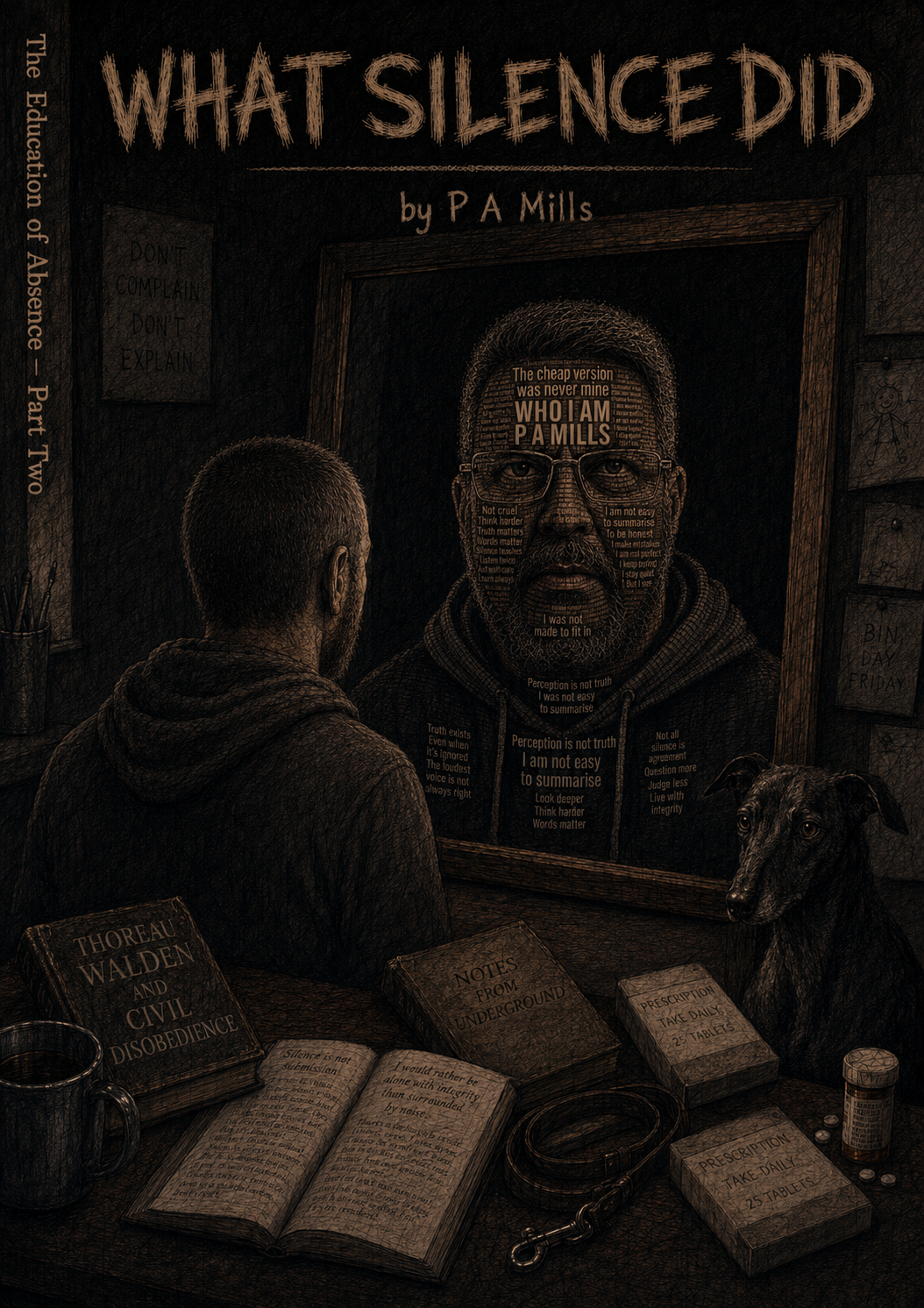
The Education Of Absence - Part Two
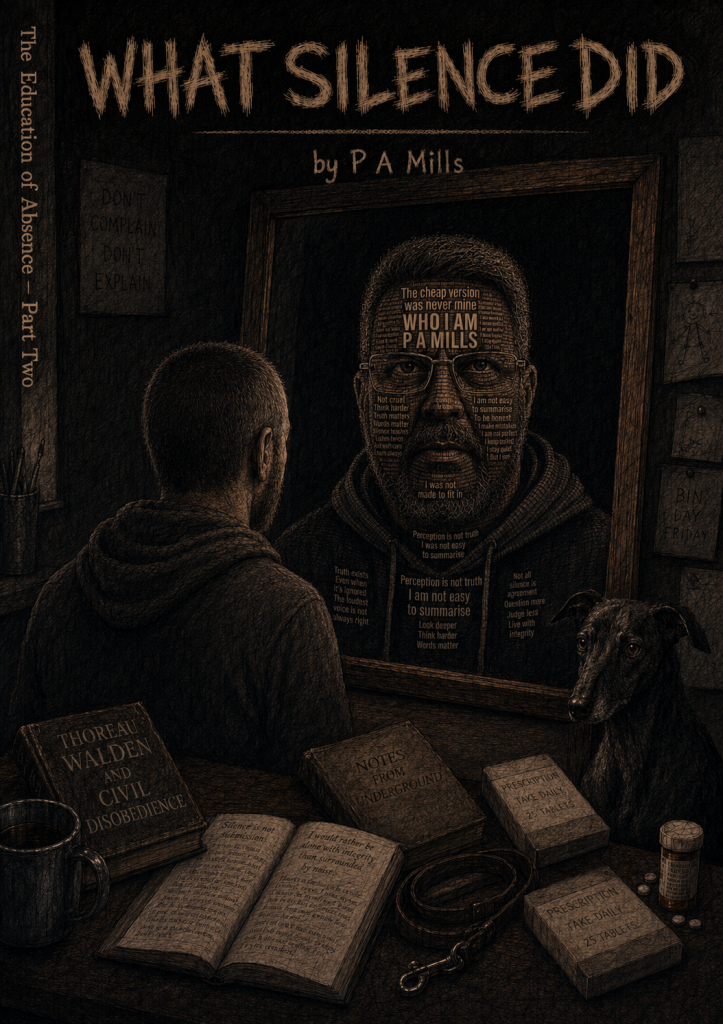
What Silence Did
by P A Mills
Absence changes your eyesight.
Not dramatically. Not with music. Not in the grand cinematic sense, where a person stands by a window, lit by rain, suddenly understanding the whole tragic arrangement of his life.
It is slower than that.
At first, absence only changes the furniture of the day. The phone becomes quieter. The rooms become larger. The kettle develops a kind of moral authority. The dog looks at you as if the collapse of civilisation is regrettable, but no excuse for delaying breakfast.
Bills still arrive.
This is one of the less advertised features of personal transformation. Electricity companies do not pause for existential reconstruction. The council does not send a letter saying, “We understand you are currently reconsidering the basis upon which you have lived. Please disregard the enclosed demand.”
No.
They want the money.
So you pay, or worry about paying, or place the letter under something heavier and call that a system.
Silence, I discovered, is not the absence of noise.
It is the removal of distraction.
That is where the trouble begins.
When the world goes quiet, you hear what has been underneath it all along. The click in the radiator. The dog breathing in sleep. Your own body making small complaints from various departments. The fridge humming with the weary persistence of a civil servant. A message not answered. A task not done. A memory behaving badly in the corner.
There is no great wisdom in it at first.
Only exposure.
The self, without an audience, is a less impressive creature than advertised. It scratches. It repeats itself. It worries at old injuries. It rehearses arguments with people who are not present and would not understand if they were. It looks for distraction in cupboards, screens, biscuits, old photographs, unread books, weather, the dog’s expression, the possibility that the postman has judged the recycling.
Then, eventually, if silence does not finish you, it begins to teach.
Not kindly.
Silence is not kind.
Silence is exact.
It has no interest in your preferred version of events. It does not applaud effort. It does not care that you meant well, suffered greatly, tried hard, nearly managed, almost became, once had promise, or were badly treated by people with better shoes.
Silence sits there.
It waits.
It lets the performance run out of fuel.
And when the performance stops, something plain remains.
Not peace. I distrust peace as a word. It has been overused by people who own too many cushions. What remains is more like eyesight. A sharper, less flattering way of seeing.
I began to see how much of my life had been noise dressed as duty.
Replying. Explaining. Softening. Performing. Making myself easier for people who had never once considered becoming less difficult for me.
I had mistaken availability for goodness.
That is an expensive mistake.
There is a particular kind of person who likes you best when you are porous. When you answer quickly. When you absorb the room. When you make your pain amusing enough not to inconvenience anyone. When you translate yourself into whatever version causes the least discomfort.
I had been very good at that.
Good enough to disappear inside it.
Silence did not make me better.
It made me less available to lies.
That is different.
Better is what people want from you when they would prefer not to examine what made you ill in the first place. Better means cheerful again. Useful again. Manageable again. Back in circulation, with the rough edges sanded down and the embarrassing truths stored somewhere private.
Less available to lies is a colder improvement.
It does not photograph well.
It does not make you popular.
It does not help at family gatherings.
One of the lies had been mine.
Not deliberately. I had not lied so much as translated myself badly for years, because translation was the price of entry. Into classrooms. Jobs. Friendships. Family rooms. Ordinary conversations where everyone else seemed to have been handed the rules in advance.
I had called it coping.
Later, I learned another word.
Autism did not arrive like a revelation. It arrived like a bill that had been sent to the wrong address for forty years.
There was anger in that.
Of course there was.
Not because a word would have saved everything. Words are not ambulances. A diagnosis does not go back through time with a clipboard, correcting school reports, family verdicts, failed rooms, bad doctors, tired teachers, frightened parents, and people who mistook distress for attitude.
But a word might have stopped some of the wrong explanations from becoming permanent.
Lazy. Difficult. Moody. Oversensitive. Rude. Aloof. Dramatic. Not trying. Trying too hard.
People are very quick to name pain badly when the correct name would require effort.
That was what hurt.
Not only being missed. People are missed every day. What hurt was being visible enough to be judged and not visible enough to be helped.
Bright enough to be expected to manage.
Strange enough to be punished when I could not.
Nobody wants to discover in middle age that the operating manual existed, but had been kept in a drawer by people who preferred guessing.
There is comedy in that, if one is feeling generous.
I am not always feeling generous.
Silence returned me to that child.
Not sentimentally. I did not find him glowing in a field, holding a symbolic balloon. I found him tired. Watchful. Performing normality with the grave concentration of a bomb disposal expert. Learning which face to use. Which truths to soften. Which sounds to endure. Which rooms to survive. Which adults were safe and which only looked safe because they smiled while misunderstanding you.
Silence is where the buried mind starts making noise.
For years I had mistaken that noise for weakness. Anxiety. Bitterness. Bad character. A failure to move on.
But the mind is not stupid.
It keeps returning to the places where meaning was stolen because some part of you is still waiting for the record to be corrected.
So the anger came.
Not wild anger. Not thrown-chair anger. Older than that. Colder. The anger of a person reading old reports with adult eyes. The anger of seeing how often distress had been filed under inconvenience. The anger of understanding that some people could have helped, and did not, because helping would have required them to stop being comfortable.
I had hidden for a long time.
Silence taught me that hiding is not peace.
It is only fear made tidy.
That was the harder education. Not becoming calmer. Not becoming wiser. Not floating above the whole miserable business like some discounted monk. But standing in the room of my own life and saying: yes, this happened. Yes, I was missed. Yes, I was misread. Yes, I helped some of that misreading by becoming useful, amusing, clever, manageable, whatever the room required.
And no, I will not keep doing it.
A person educated by silence becomes awkward in rooms built on pretence. They stop laughing where laughter is required. They notice the little arrangements. The friendly cruelty. The cowardice wearing concern. The gossip dressed as worry. The insult wrapped in “only joking.” The person who throws the stone and then becomes wounded by the sound of glass.
Silence made these things louder.
That was the oddity of it.
From a distance, the world became noisier. Not deeper. Not more dangerous. Just noisier. Full of statements, reactions, announcements, offences, performances, little collapses dressed as principles. The old human circus, now with better phones.
It would be funnier if it were not so common.
Though, to be fair, it is still funny.
There is no point surviving life if one cannot occasionally admire the comic engineering of human stupidity.
I became less tolerant of it.
Not cruel. I hope not.
But severe.
There is a difference.
Cruelty enjoys harm.
Severity refuses theatre.
Severity says: no, I will not join in merely because joining in would make you feel less ridiculous. No, I will not turn a lie into a social convenience. No, I will not keep explaining myself to people committed to misunderstanding me professionally.
This is not wisdom.
It is fatigue with better posture.
Silence teaches by subtraction.
It removes the excess. The gestures. The need to be seen by people with damaged eyesight. The childish hope that if you arrange the words perfectly, the wrong people will suddenly become fair.
They will not.
This, too, is education.
Some people are not confused. Some people are invested. Some do not misunderstand you. They understand enough to continue.
Absence shows you this.
It shows you who knocks when there is no performance to attend. Who arrives when you are boring. Who can sit in the unglamorous room with the damp towel, the prescription bag, the unpaid thing, the old dog hair on the jumper, and not require you to become inspirational for their comfort.
These people are few.
That is not tragic.
It is clarifying.
The world gives you thousands of faces and calls that a life. Silence reduces the number. It is almost rude about it. It takes away the crowd, then the acquaintances, then the spectators, then the people who enjoyed your wound as long as it behaved like theatre.
What remains is smaller.
Better proportioned.
There are days when this feels like loss. There are other days when it feels like being released from a very badly organised committee.
I do not wish to oversell it.
Isolation is not noble. Pain is not a university. Grief does not make you interesting. Illness does not hand out wisdom like a village raffle. There is no prize for enduring things, except occasionally enduring them.
Much of absence is dull.
Brutally dull.
It is laundry. Tablets. Dog walks. Reheated food. Standing in a shop wondering why you came in. Trying to remember whether the chest pain is anxiety, digestion, doom, or merely the body producing experimental jazz.
It is waking at strange hours and finding the world intact without your supervision.
That part is offensive.
You suffer privately, and outside, people continue reversing badly into parking spaces. Someone buys a sausage roll. Someone complains about roadworks. A man in shorts walks past in February, as if temperature is a rumour spread by weaklings.
Life goes on.
Not beautifully.
Just on.
And in that continuing, there is a kind of instruction.
The ordinary does not care for your drama, but neither does it abandon you. The kettle boils. The dog needs walking. The bill needs paying. The towel needs hanging up properly, for once, instead of left in a damp philosophical heap.
Routine becomes a low form of mercy.
Not because it heals you, but because it gives the day a handle.
You get up because the dog does not understand despair as a scheduling principle. You eat because the body is unimpressed by theory. You wash a cup because civilisation, in the end, may be no more than the decision not to leave everything sticky.
This is where silence did its best work.
Not in revelation.
In reduction.
I stopped wanting to be impressive.
That was one mercy.
Impressive is exhausting. It requires lighting. It requires witnesses. It requires the constant maintenance of a self that can survive public inspection. It asks you to turn every wound into material, every thought into evidence of depth, every survival into a little speech.
Silence made that embarrassing.
I began to prefer the unannounced thing. The page written without applause. The walk taken without proof. The kindness not photographed. The thought kept long enough to become true.
There is freedom in not performing.
There is also loneliness.
I will not pretend otherwise.
The room does not congratulate you for being authentic. The dog, though loyal, has limited interest in the development of the inner life. The post still comes. The body still keeps its own minutes. The past still finds ways to cough in the wall.
But the loneliness is cleaner than performance.
It asks less lying of you.
And that matters.
Absence did not make me serene. It made me quieter. More severe. Less needy. Less willing to entertain nonsense merely because nonsense had arrived with confidence and a loud voice.
Rooms became simpler. Some doors stayed shut. Some explanations stayed in my mouth. Some emergencies revealed themselves as noise.
Some silences are not empty.
Some are rooms after the wrong people have left.
And there, in the space they used to occupy, eyesight returns.
Not happiness.
Not victory.
Not peace with tragic music swelling under the credits.
Eyesight.
The plain, hard gift of seeing what is there.
The bills. The dog. The body. The work. The diagnosis. The old child. The anger. The seriousness of what remains.
Silence did not save me.
It showed me what had been costing too much.
And once you have seen that clearly, you cannot go back to paying.