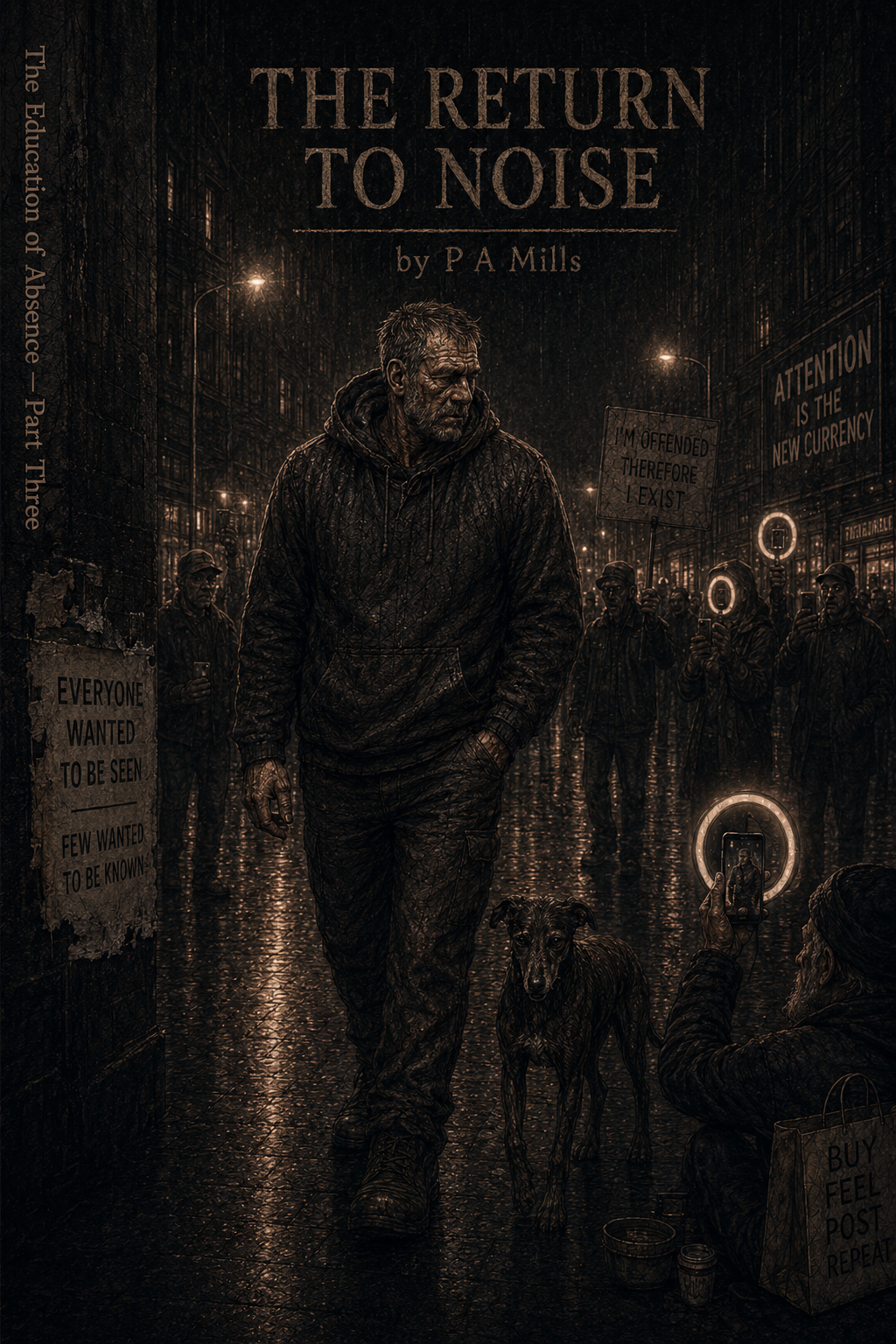
The Education Of Absence - Part Three
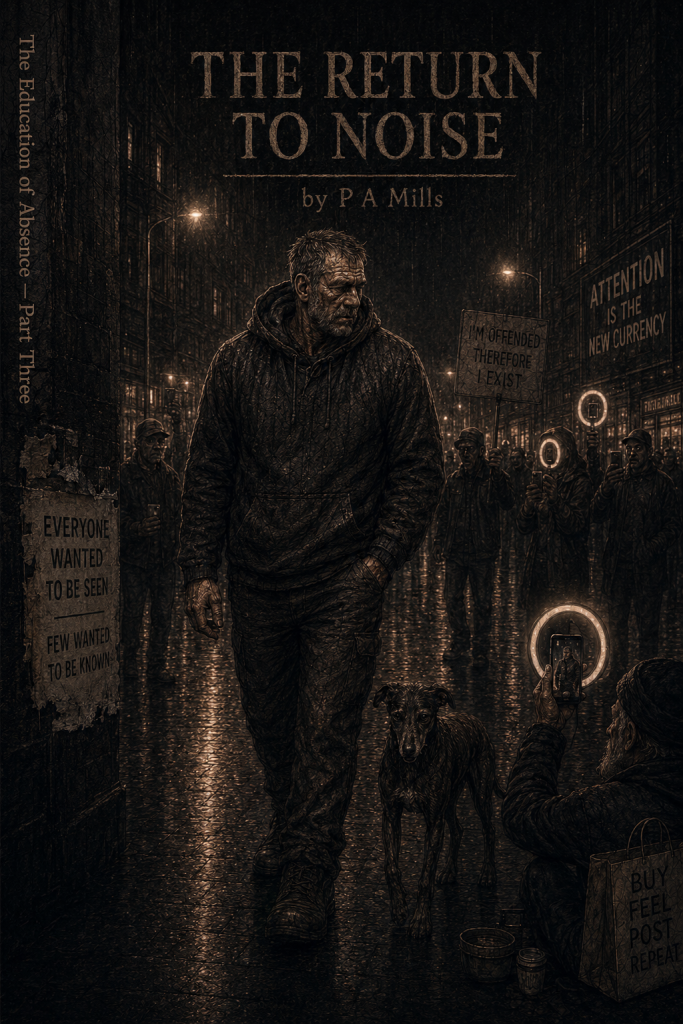
The Return To Noise
Notes from a man who came back quieter
by P A Mills
I thought I had left the world for a while.
I had not.
I had only stepped far enough away to see it properly.
That is the useful thing about absence. It does not make the world disappear. It removes the obligation to keep pretending the world is sane.
For years I thought I was writing about society. Families. Pubs. Politics. Illness. Dogs. Committees. Cruelty. Cowardice. The shallow little courts people build so they can pass judgement without evidence and call it concern.
I was not writing separate pieces.
I was writing one wound from different angles.
I realised this while speaking to my wife. Just an ordinary sentence, said because ordinary sentences sometimes carry what polished ones avoid.
I said I did not think I had ever felt secure since looking after my grandmother.
I was eleven.
She had dementia.
The adults had names for what was happening, but names did not make the house safe.
There it was.
Not a theory. Not a pose. Not one of those decorative explanations people attach to themselves when they want sympathy without examination.
A fact.
Some people grow up believing the world is basically held together. That adults know what they are doing. That systems arrive when needed. That love protects. That the floor is there because the floor has always been there.
I did not keep that belief.
I was too young to be useful and useful anyway.
Somewhere early, care became alarm. Love became vigilance. Home became a place where you listened for changes in breathing, tone, weight, mood, weather. You learned the small sounds that mean something is wrong. You learned that a person can be needed before he is ready. You learned that safety is not a condition. It is only a temporary failure of disaster to arrive.
After that, you do not live in the world quite as other people do.
You watch it.
You test the boards before putting your full weight down. You listen behind what is said. You notice the shift in a room before the room admits it has shifted. You distrust public certainty because you have seen private collapse. You learn that the official version of life is usually written by people who did not have to clean anything up.
So when I left the world for a while, it was not a grand withdrawal.
It was not Walden. There was no pond. No cabin. No noble refusal of society admired later by people with excellent coats.
I was removed by the ordinary machinery of survival: illness, fear, duty, exhaustion, money, the body, the dog, the letter on the table, the phone lighting up like a summons, the person I loved breathing in the next room, the next appointment, the next form, the next small crisis walking towards me with its shoes already on.
Life did not transform me.
It wore me down until the decorative parts fell off.
At first I thought that was loss. Then I began to understand that much of what falls away under pressure was never strength. It was performance. The social version of myself, polished for rooms I never trusted, softened for people I did not believe, made reasonable for systems that had no intention of being reasonable back.
Silence did not comfort me.
Silence removed the audience.
Once the audience is gone, a man finds out what he has been doing for applause. He finds out which parts of his suffering are real and which parts have learned to speak for effect. He finds out whether his love is language or labour. He finds out whether his anger is justice or only heat. He finds out whether he has spent half his life asking mad rooms to become fair because he was still hoping some adult would arrive and make them fair.
That was the part I had not wanted to know.
I had not only been judging the noise.
I had been bargaining with it.
Explaining myself to it. Softening myself for it. Performing harmlessness for it. Trying to make my private life legible to people who could barely read their own motives. Hoping, even then, that if I found the right words, the room would stop lying.
But silence took even that.
I did not become peaceful.
I became less available.
There is a difference.
When I came back into the world, I expected noise. Britain has always had noise. Dogs, bins, buses, drills, pubs, neighbours, weather, the idiot with an engine where his personality should be. None of that was new.
What was new was the need.
Everywhere I looked, people seemed to be begging to be witnessed. Not helped. Not changed. Witnessed. Confirmed. Applauded. Excused. They had mistaken being seen for being real, and once a culture makes that mistake, it begins to lose its mind in public.
People had not become ill.
They had become theatrical.
That distinction matters.
Real mental pain deserves care, quiet, medicine, patience, protection, and a seriousness this society rarely gives it. I am talking about something cheaper and louder. A cultural madness. A performed instability. The adult tantrum dressed in educated language. The public wound used as passport, leverage, identity, costume, or applause.
Real pain often makes people quieter.
Performance asks where the camera is.
That is what I came back to.
A world in which adults had learned the language of injury but not the discipline of adulthood. They could announce harm but not endure disagreement. They could speak endlessly of boundaries while trespassing through everybody else’s peace. They could call themselves honest while being merely cruel, then call cruelty trauma when honesty came back across the table.
It would have been funny if it had not become public life.
Everywhere, people were convening little courts. No evidence required. No patience. No proportion. No humility before another human being’s complexity. A face, a sentence, a rumour, a post, a tone, a pause, a silence — enough. The verdict could be delivered before breakfast and decorated with concern by lunch.
This is not seriousness.
It is appetite in a gown.
Much of what now passes for morality is only appetite that has found respectable clothes: the appetite to accuse, to be central, to turn private discomfort into public weather, to make every room responsible for the weather inside your own head.
I recognised it because I had known appetite too.
The appetite to be understood.
The appetite to be finally seen.
The appetite to drag the whole room towards the wound and say, there, look, that is where it started, now will you believe me?
There is nothing shameful in wanting to be understood.
But there is danger in needing the wrong people to do it.
That may be the hardest lesson absence gave me. Not that society is noisy. Any fool can see that. Not that people are performative. That is hardly news. The harder lesson was that I had once wanted admission from the same theatre I despised.
I wanted the mad room to admit it was mad.
It will not.
That is why silence becomes dangerous. It gives you back to yourself without committee, without comment thread, without village, without audience leaning forward to reward your best version. Just you, your history, your bargains, your dead, and the child still waiting for the house to become safe.
Most people do not want that.
I understand why.
A person alone in a room is a terrible thing when the costume comes off. No caption. No witness. No public excuse. No applause for surviving badly. No little speech prepared for strangers who were never going to listen.
And perhaps that is why the modern world cannot leave itself alone. It has to announce, react, explain, photograph, diagnose, forgive, denounce. It has to make a ceremony out of every feeling because, without ceremony, the feeling might pass.
And if the feeling passed, what would be left?
A person, perhaps.
That seems to be the terror.
I have no use for that terror anymore. Or less use, at least. I know it too well to worship it.
That may sound arrogant. It is not. Arrogance still wants a throne. I want fewer rooms.
Fewer performances. Fewer staged injuries. Fewer public collapses. Fewer people mistaking their volume for depth. Fewer amateurs in judgement robes. Fewer demands that every private wound become public property before it is believed.
Because silence, brutal as it is, has one virtue.
It does not flatter you.
It does not call your weakness authenticity. It does not call your temper justice. It does not call your cowardice sensitivity. It does not turn your self-pity into a philosophy and send it into the world wearing good shoes.
It leaves you there.
And eventually, if you are lucky or desperate enough, you stop performing and begin.
That is what happened to me, I think.
Not healing. Not enlightenment. Nothing so marketable.
I simply became harder to lie to.
So when I came back and saw the noise, I recognised it. Not because I was above it, but because I had made enough of it myself. I knew the taste of performance. I knew the comfort of anger. I knew the little relief of being misunderstood, because being misunderstood can save a man from being examined.
Then absence took even that.
What remained was colder.
Cleaner.
Less useful to other people’s theatre.
I left the world for a while.
When I returned, it had become a nursery with broadband, a courtroom without evidence, a church without God, and a theatre with no interval.
Everyone wanted to be seen.
Few wanted to be known.
And I understood, perhaps too late, that security was not coming from the room. Not from the family, the crowd, the system, the little courts, or from being finally understood by people addicted to misreading.
The floor I had been waiting for was not going to be given back.
So I stopped waiting