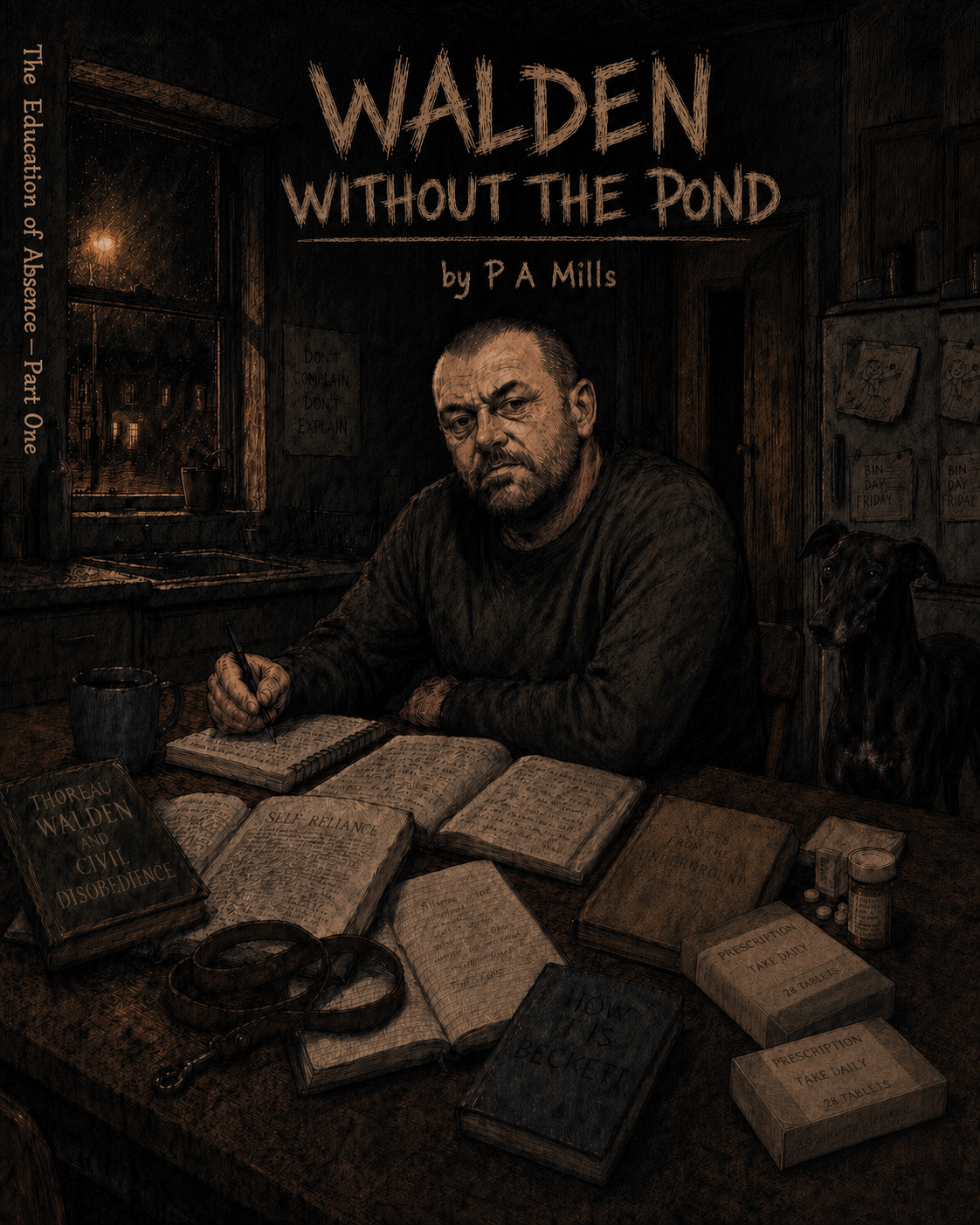
The Education Of Absence - Part one
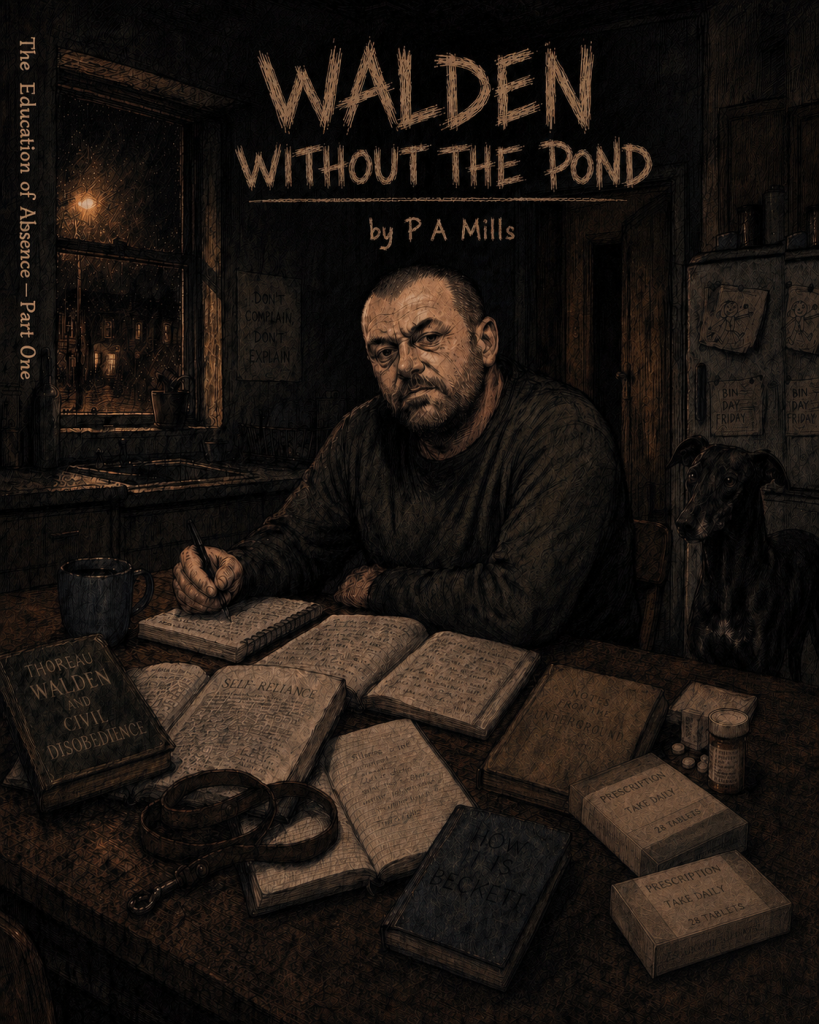
Walden Without the Pond
by P A Mills
I did not go to the woods to live deliberately.
That should be made clear from the beginning.
There was no pond. No cabin. No clean American morning with mist rising over the surface of the self. No beans. No noble refusal of society. No handsome little experiment in simplicity later admired by people who own six jackets for walking.
My Walden had bills on the sideboard, damp towels, prescription bags, unread messages, and a dog looking at me as if philosophy was no excuse for a late walk.
I did not withdraw from the world because I had become wise.
I withdrew because life, in its usual delicate manner, put a hand on the back of my neck and pressed my face into the facts.
Illness does that. Grief does that. Failure does that. Family does that. Fear does that. The long, humiliating admin of survival does that. It narrows the day until the day becomes a corridor, and you walk it because there is nowhere else to go.
At first, isolation feels like punishment.
Then, if it does not finish you, it becomes education.
Not the sort with certificates. Not the sort people announce online beside a photograph of a notebook and coffee, as if concentration has become an aesthetic choice. This was not personal development. This was not healing. This was not a journey, unless a man crawling through his own wreckage counts as travel.
It was re-education by pressure.
There are lessons one only learns when the room has gone quiet enough to hear them.
You learn how much of ordinary life is theatre. How much friendliness is management. How much concern is curiosity in a clean shirt. How much adult conversation is nothing more than fear passing itself around under different names.
You learn that silence is not empty.
Silence is crowded.
It contains everything people said. Everything they did not say. Everything you should have noticed. Everything you pretended not to understand because understanding it would have required a decision.
That is the trouble with absence.
It gives the mind time to produce evidence.
So one reads.
Not to look clever. God spare us from that particular little circus.
One reads because the mind needs tools, or it starts using teeth.
Books became less like decoration and more like instruments. Philosophy, history, essays, fragments, notes from men who had also looked at civilisation and found it wearing a false moustache. Stoics. Satirists. Miserable prophets. Comic executioners. Men in rooms. Men on roads. Men waiting. Men watching the human animal explain itself badly and at length.
And beneath them all, that old severe instruction:
Look properly.
Not happily. Not hopefully.
Properly.
That is where the education begins.
You stop asking whether life is fair because the question starts to embarrass you. You stop expecting people to behave according to the speeches they give about themselves. You stop confusing noise with strength, confidence with intelligence, sympathy with loyalty.
You learn that restraint is not weakness.
You learn it because you possess the opposite.
Discipline is not an accessory for men who quote Marcus Aurelius beneath gym photographs. Discipline is the small, ugly, daily act of not making things worse.
It is biting down on the sentence that would satisfy you for five seconds and cost you five years.
It is walking the dog when the mind wants war.
It is washing a cup.
It is answering gently when the soul has already drafted a much better reply involving fire.
No one applauds this.
There is no medal for not becoming the worst thing available to you.
But there should be.
The world praises performance because performance is visible. It has no real language for private restraint. It does not know what to do with the battles a person wins by sitting still.
So the education continues unseen.
A man becomes quieter. Not necessarily kinder. Let us not overstate the matter. But quieter. More exact. Less willing to be recruited by panic. Less interested in the public rituals by which people prove they are good without having to become useful.
And this, I think, is what solitude does when it does not rot the mind.
It removes the audience.
That is its first mercy.
Without the audience, many of the self’s favourite tricks become pointless. There is nobody to impress with suffering. Nobody to charm with cleverness. Nobody to convince with the approved version of events. There is only the plain, unpleasant labour of being alone with what is true.
This is where a man either deepens or becomes very strange.
Often both.
I became strange, certainly.
But I also became harder to fool.
Not wise. Wisdom is too grand a word, and usually claimed by people who have mistaken tiredness for enlightenment.
Sharper, perhaps.
I began to see the machinery.
The small cowardices dressed as kindness. The gossip dressed as concern. The cruelty hidden in politeness. The committee-brain of people who cannot think alone but feel brave in a cluster. The way adults borrow each other’s certainty because none of them can afford their own.
Because my life had become smaller, the details grew larger.
A tone of voice.
A silence after a message.
A question asked too eagerly.
A face arranged into sympathy but powered by appetite.
This is not paranoia. Paranoia invents patterns. Education recognises them.
There is a difference, though the modern world prefers not to notice differences. They slow the shouting down.
So there I was, in my poor man’s Walden.
No pond.
No hut.
No fine moral weather.
Just rooms. Books. Illness. Duty. The dog. The kettle. The old philosophers muttering from the shelf. The daily fact of continuing.
And slowly, without ceremony, the world I had left began to lose its authority.
Not because I hated it.
Hatred gives the world too much importance.
But because I had seen what remains when its noise is removed.
Most of it is not serious.
Most of it is appetite, fear, habit, vanity, and weather.
And yet, eventually, one must go back.
The door opens.
The street waits.
The messages begin again.
People ask how you are, though many of them mean, “Tell me something I can carry to someone else.”
The ordinary world resumes its little performance.
Only now, there is a problem.
You are not the same audience.
That is the beginning of re-entry.
Not the return.
The difficulty of return.
Because one does not emerge from solitude into society as a healed man entering light. That is for films and people who use the word closure without shame.
One emerges blinking, altered, carrying the wrong equipment for the age.
You come back with silence in you.
The world has upgraded its noise.
You come back having learned to read slowly.
The world has become a room full of people reacting to headlines they did not finish.
You come back having studied restraint.
The world has decided restraint is suspicious unless rebranded as trauma response.
You come back having fought to become an adult.
And there, waiting for you, are adults.
Tall ones.
Many of them with mortgages, children, reading glasses, blood pressure tablets, and the emotional discipline of a dropped trifle.
That is when the joke begins.
That is when you realise you had not escaped reality.
You had been studying it.
The world, meanwhile, had been on its phone