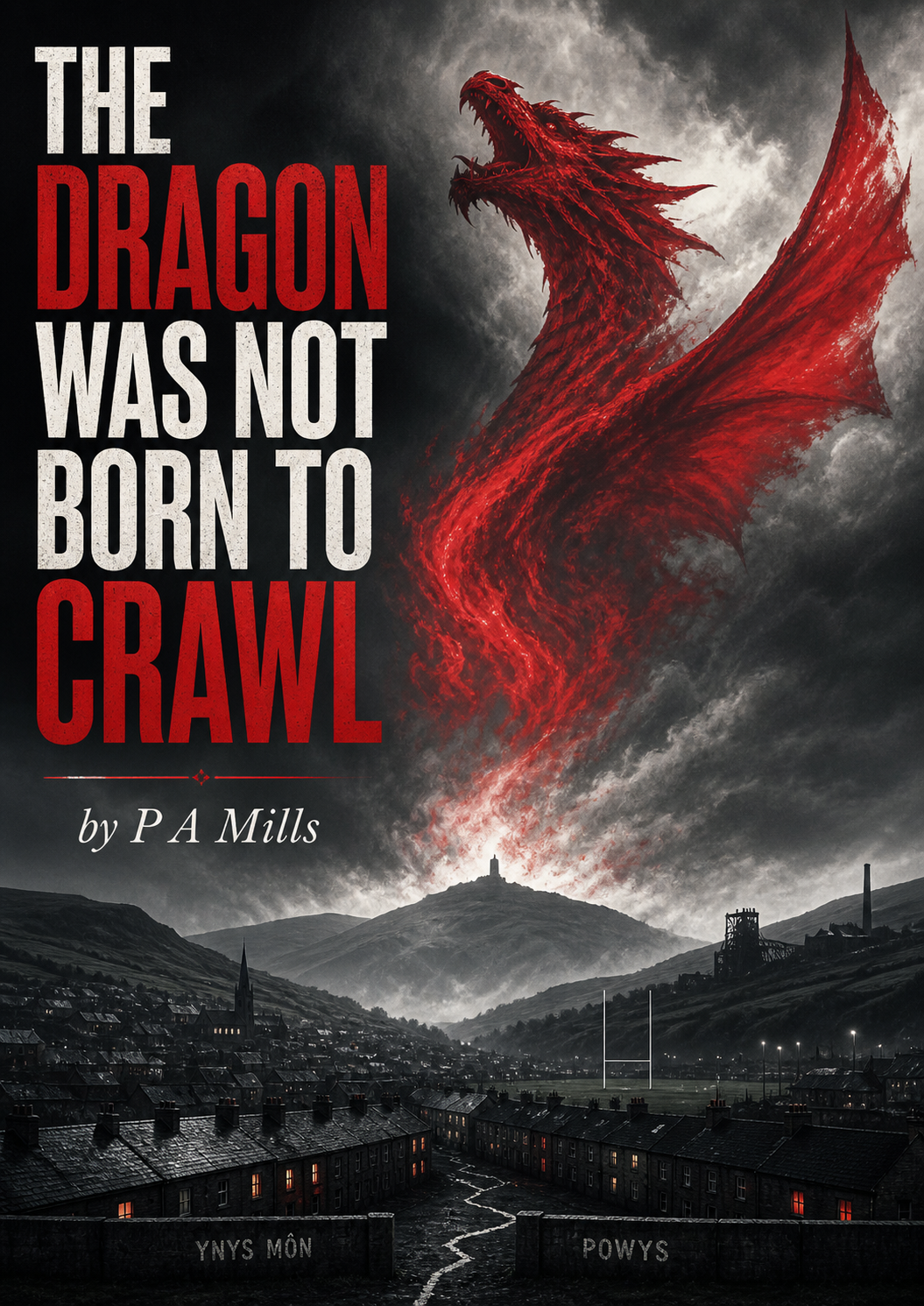
The Dragon Was Not born To Crawl
The Dragon Was Not Born to Crawl
by P A Mills
I make no tribal claim here.
I have simply lived close enough to Wales to see what captivity has taught it to call character.
I do not write by birthright, bloodline, or inherited grievance. I write as one who lives here, cares for what is stubborn in this country, and has spent enough of life outside the room to recognise what a room does to those trapped inside it.
Sometimes the outsider sees the ritual more clearly.
Not because he is superior.
Because he has not been trained to mistake the ritual for truth.
And one of the rituals I see in Wales is division.
Not the honest disagreement that belongs to any serious people. Argument is healthy. Argument is how adults sharpen thought before they walk into history.
No.
This is smaller than argument, and therefore more poisonous.
Village against village. Valley against valley. Club against club. North against South. Welsh-speaking against non-Welsh-speaking. Cardiff against everywhere else. Everyone with a grievance. Everyone with a memory. Everyone with a grandfather who knew exactly why those bastards down the road were never to be trusted.
You see it in rugby most clearly because rugby, like all national religions, tells the truth by accident.
A country of just over three million people, with the emotional intensity of a volcano and the organisational instincts of a pub argument, still manages to spend half its strength fighting itself before the opposition even arrives.
And then people wonder why Wales is governed.
This is not an accident.
A conquered people do not merely lose castles, laws, land, language, and authority. They inherit a psychology. Wales was conquered by Edward I, legally reordered under the Statute of Rhuddlan in 1284, and later incorporated into the English legal system through the Laws in Wales Acts of the sixteenth century.
That is not ancient bitterness.
That is context.
Power does not need to invent every division. It only needs to profit from them. It does not need to silence every Welsh voice if Welsh voices are busy shouting each other down. It does not need to break the dragon if the dragon can be persuaded to bite its own tail.
And Wales has been too good at that.
There is an old trick in politics: damage a people, then cite the damage as proof of their incapacity.
Tell them they cannot stand because they have spent centuries being leaned on.
Tell them they cannot speak because their language was treated as an embarrassment.
Tell them they cannot govern because government was held elsewhere.
Tell them unity is impossible, after generations of being rewarded for fragmentation.
Then smile, and call the arrangement stability.
That is how smallness is manufactured. Not always by violence. Not always by law. Sometimes by habit. Sometimes by ridicule. Sometimes by teaching a people to lower their expectations until caution begins to feel like wisdom.
And yet there is something obscene in it.
A people who built chapels into hillsides, sang grief into harmony, sent coal and steel into the bones of the modern world, kept a language alive through contempt, and produced poetry from rain and discipline, are now expected to believe they are too small to govern themselves.
Too poor.
Too divided.
Too emotional.
Too dependent.
Too Welsh, presumably.
This is where the dragon matters.
Not as merchandise. Not as mascot. Not as tea towel, tourist trinket, rugby-day decoration, or polite ceremonial flourish where everyone pretends symbolism is a substitute for power.
The dragon is an old argument in red.
It says Wales is not a region with scenery. It is not a sentimental appendix to someone else’s state. It is not a picturesque administrative problem west of Offa’s Dyke.
It is a nation.
Which is why even the rugby shirt matters.
Not because a badge alone decides a country’s future, but because symbols teach obedience long before arguments arrive. Wales, the land of the dragon, has too often worn the feathers of another authority and called it tradition. The old badge of the Prince of Wales — foreign in motto, royal in ownership, imperial in implication — still sits where the dragon might have stood.
That is not the greatest injustice in Welsh history.
But it is a useful little emblem of the larger one.
A nation that spends its life asking permission eventually forgets the sound of its own command.
This is why Welsh independence, properly understood, is not hatred of England. Hatred is cheap. Hatred is for people who need an enemy because they cannot produce a future.
The argument is not that England is uniquely wicked.
The argument is that no nation should live permanently inside another nation’s arithmetic.
England does not need to conspire against Wales. It only needs to be much larger. That is enough. Its population, media, economy, and political gravity bend the whole structure toward itself. Wales can vote, speak, object, request, negotiate, and explain. But in the final analysis, it remains too often a minority inside a state whose centre of weight lies elsewhere.
That is not partnership.
That is polite containment.
And adult discussion begins by dropping the village stupidity.
Because if Wales wants freedom, it must first stop rehearsing captivity.
The rugby rivalries can stay. The accents can stay. The local pride can stay. The jokes can stay. The arguments can stay. God help us, even the committee meetings can stay.
But not the cheese-and-wine parties.
Not the polite little rooms where nothing dangerous is said, nothing structural is named, and everyone congratulates themselves for mistaking manners for courage.
The pettiness must not lead.
A people cannot build a country while still measuring dignity by who beat whom in a schoolboy match in 1986.
There has to be a larger Wales than that.
A Wales where Welsh-speaking and English-speaking citizens are not treated as rival species. A Wales where North and South are not competing wounds. A Wales where the valleys are not museum pieces, the west is not folklore, the cities are not presumed alien, and rural life is not patronised as scenery.
A Wales where identity is not nostalgia, but responsibility.
That is the word the sentimentalists avoid.
Responsibility.
Independence would not save Wales by magic. It would not fill every hospital bed, repair every road, revive every town, or make every fool suddenly useful. There would still be incompetence. There would still be vanity. There would still be politicians with the moral weight of damp cardboard.
But at least they would be Wales’s to remove.
That matters.
Because self-government is not the guarantee of wisdom.
It is the ownership of consequence.
And Wales has lived too long with consequence without ownership.
I know something of standing beyond the accepted circle and watching people mistake membership for intelligence. I know something of rooms where everyone agrees to the lie because the lie is socially convenient.
Distance does not always distort.
Sometimes it clarifies.
The person outside the room can sometimes hear the machinery better than those applauding inside it.
And the machinery here is old.
It says: stay small.
Stay local.
Stay suspicious.
Stay grateful.
Stay divided.
Call it realism.
Call it maturity.
Call it not rocking the boat.
But boats that never rock often never move.
So the call is simple.
Stop crawling around the old injuries.
Stop mistaking local rivalry for national character.
Stop letting the dragon appear only when there is a match, a song, or a funeral.
A dragon is not summoned to decorate defeat.
It is summoned to remind a people what they were before fear taught them to be reasonable.
Wales does not need to become arrogant.
It needs to become serious.
It needs to gather itself. Not as one accent. Not as one class. Not as one language. Not as one party. Not as one valley, city, farm, chapel, club, estate, or coast.
As one country.
The dragon was not born to crawl from village to village, arguing over scraps beneath the table.
It was born to rise.
And the first act of rising is this:
Recognise the oldest division for what it is.
Not personality.
Not destiny.
Not Welshness.
A wound.
And wounds either become identity, or they are finally healed.
Wales must choose.