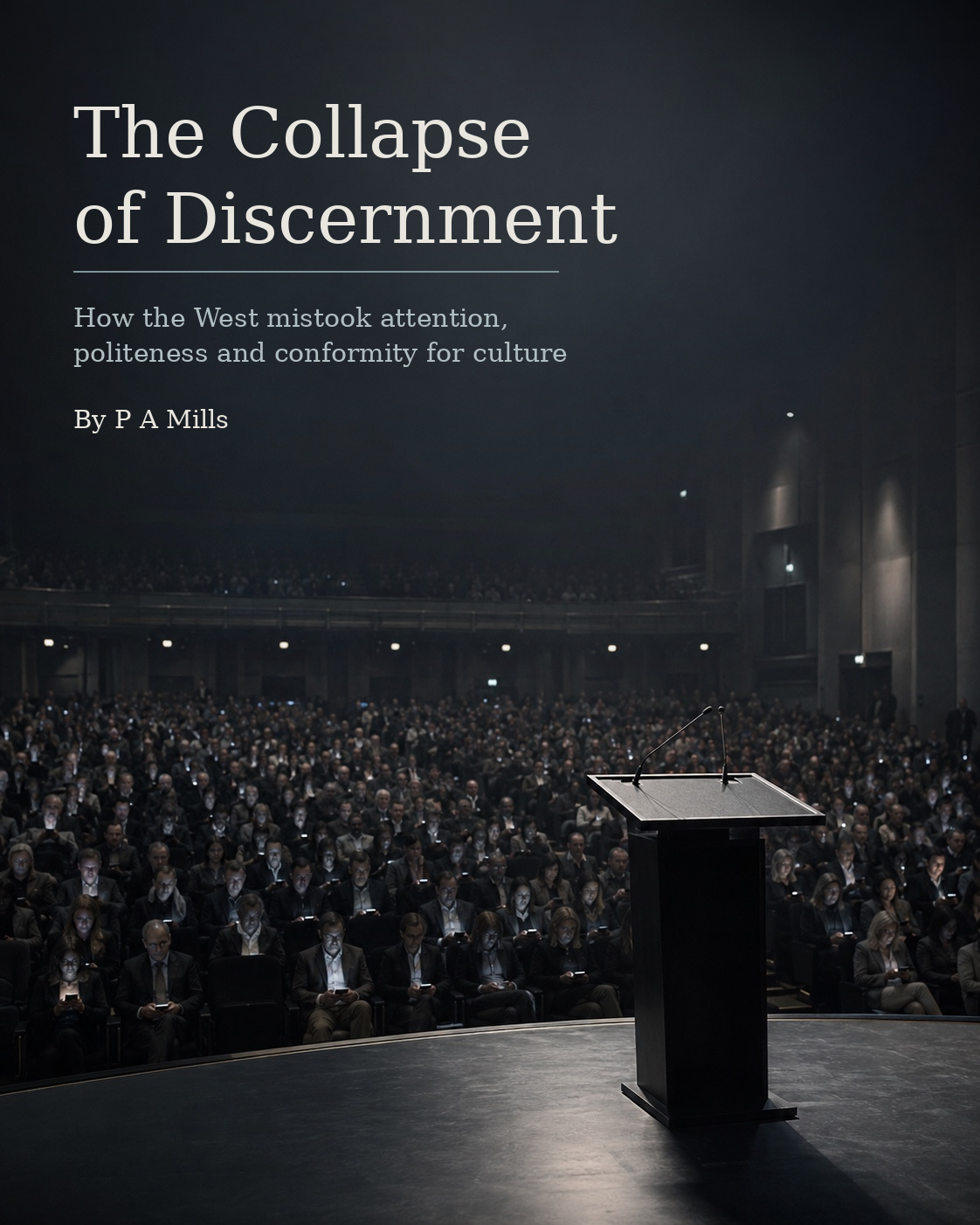
The Collapse of Discernment
How the West mistook attention, politeness and conformity for culture
By P A Mills
The modern West has developed a strange talent for agreement.
Not conviction. Not thought. Not the slow consent of a mind persuaded by evidence, enlarged by art, or sharpened by argument. Agreement of a cheaper, more nervous kind. The room now knows when to clap before it knows what has been said. It knows which shows are “important,” which opinions are acceptable, and which silences may be treated as guilt.
This is not culture. It is choreography.
A civilisation that once made grand claims for conscience, liberty, literature and the dignity of the individual mind now behaves too often like a crowd waiting for instructions. It does not ask whether something is true. It asks whether the approved people have endorsed it. It does not ask whether something is beautiful. It asks whether it has been marketed as brave. It does not ask whether a person has thought. It asks whether he has performed the recognised signs of thought.
The result is not barbarism in the old sense. Barbarism, at least, has appetite. What we have now is flatter, colder and more managed: rehearsed responses, approved rebellion, and public manners standing in for private virtue.
The past should not be romanticised. It was often cruel, narrow, hypocritical, class-bound, prejudiced and pleased with itself. It excluded people while speaking of freedom. It preached dignity while denying it. No serious defence of Western values can require amnesia about Western failure.
But the best of the Western inheritance supplied the standards by which those failures could be accused. It gave us the argument against tyranny, the sanctity of conscience, the private revolution of the book, and the idea that one person might stand against the room and still be right.
That inheritance has not been defeated by superior intelligence.
It has been thinned.
The great confusion of our age is the belief that visibility is value. The conspicuous thing becomes the important thing. The loudest voice becomes the representative voice. The most shared opinion is mistaken for the most valid. The fool, once limited by the embarrassment of his own ignorance, now discovers that ignorance can be converted into presence. He need not know anything. He need only react quickly, loudly and in the approved direction.
This is not democracy. It is attention without judgement. The platform has not merely given everyone a voice; it has removed the old social cost of having nothing to say.
A healthy culture depends on discernment. Not snobbery. Not credential worship. Some of the wisest people have never been near a university, and some of the emptiest have spent their lives inside one. Discernment is the capacity to distinguish art from content, argument from opinion, kindness from etiquette, and courage from display.
That capacity is weakening.
The evidence is everywhere. It is in media that produces garbage lit like scripture and sold as depth. It is in entertainment that announces its own importance before anyone has had time to notice its emptiness. It is in the language of “bold,” “urgent” and “necessary,” applied to work that is often derivative, timid and morally pre-chewed. Culture now explains itself in advance, as if afraid the audience might otherwise be forced into judgement.
Art has not been abolished. It has been processed.
Literature has not been burned. It has been placed in a content category.
Originality has not been banned. It has merely been made acceptable only after it has been branded, softened and made socially legible.
The modern audience is not always asked to encounter work. It is asked to consume a position. To like the right thing. Dislike the right thing. Signal the correct understanding before private judgement has had a chance to form. The question is no longer, “Is it good?” The question is, “What does liking it say about me?”
This is how taste dies: not through disagreement, but through substitution. The private encounter is replaced by the public pose.
The same decline is visible in manners. We are often told the present is kinder than the past. In some obvious ways, it is. Many cruelties once defended as tradition have been exposed. Many people once treated as inconvenient have been allowed, at last, to describe their own lives.
That is progress, and it should not be dismissed by those who confuse bitterness with insight.
But a society may learn the language of compassion without acquiring the discipline of it. It may become fluent in public sensitivity while remaining cowardly, conformist and vicious beneath the surface. It may know exactly what to say and still not know how to be decent. It may police tone while ignoring truth.
We did not necessarily become more moral.
We became more rehearsed.
False politeness is not harmless. It creates a culture in which people do not tell the truth, but merely avoid being seen telling the wrong lie. Everyone learns the dance: the safe sympathies, the approved outrage, the correct gestures of public virtue. Beneath that theatre, resentment grows. Stupidity grows. Cruelty grows more careful about its vocabulary.
The modern West has not abolished cruelty. It has given cruelty better manners.
To view this as an autistic person is to notice the machinery more than the music. The social scripts appear with unusual sharpness: borrowed emotions, sudden agreement, phrases passed around like uniforms, the way a room decides what is true before anyone has argued for it. One notices when warmth is procedure. One notices when kindness is theatre. One notices when a person has not formed an opinion but has successfully located the one currently in fashion.
This is not a claim to superior virtue. But there is a vantage point in not instinctively trusting the dance. The world often says the autistic person has failed to understand the room. Sometimes the opposite is true. Sometimes he has understood it too literally and too well.
The pressure now is not merely to agree, but to become legible. Dress the same. Speak the same. Admire the same things. Even rebellion arrives in uniform.
This is a strange fate for a civilisation that once took pride in the individual conscience.
The West at its best was never merely a geography, an economy or a flag. It was an argument. Often hypocritical, often violent, often betrayed by its own institutions, but still an argument: between liberty and authority, conscience and conformity, beauty and utility, the crowd and the solitary mind. Its greatest achievements came not from agreement but from tension: the artist against the academy, the dissenter against the church, the citizen against the mob.
Now the mob need not gather in a square.
It refreshes.
The danger is not that everyone must think the same by force of law. The danger is subtler: that people increasingly choose sameness because it is safer, quicker and socially rewarded. They outsource judgement to the room. Taste to the market. Morality to slogans. Thought to reaction.
What remains is a society crowded with expression and starved of inwardness.
The defence of Western values cannot be reduced to nostalgia, flags, empire, border rhetoric or sentimental speeches about the past. Those are too often gestures defending an image rather than an inheritance. The West worth defending is the West of argument, literacy, conscience, scepticism, artistic risk, moral courage and the right to stand alone.
That West is not dead.
But it is being drowned out by noise.
Its survival will not depend on louder opinions. We have enough of those. It will depend on the recovery of judgement: the willingness to read slowly, look properly, argue honestly, praise carefully, dislike intelligently, and resist the obscene modern demand to turn every inner conviction into public performance.
A civilisation does not collapse because people disagree. Disagreement is often proof that it is alive. It collapses when thought is replaced by positioning; when art becomes content; when kindness becomes choreography; when ignorance becomes authenticity; when the worst rise not because they are strong, but because the room has been redesigned to reward their lack of height.
The tragedy is not that the modern West has no values.
The tragedy is that it still has the words for them, and increasingly fewer people who understand what they cost