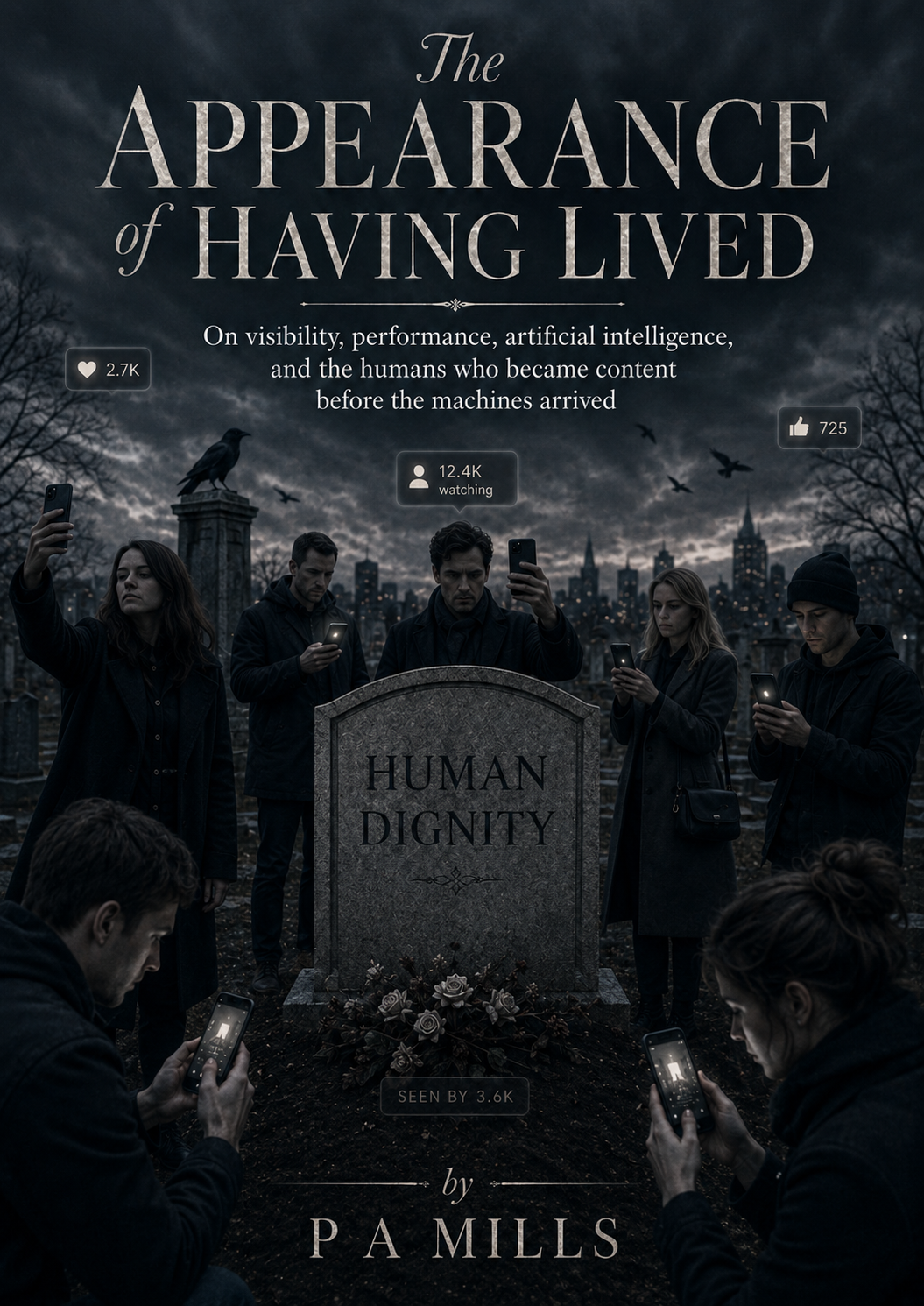
The Appearance of Having Lived
On visibility, performance, artificial intelligence, and the humans who became content before the machines arrived
by P A Mills
There was a time when people took photographs because something had happened.
Now things happen because photographs are required.
That may be the cleanest little autopsy of the age. Not complete, obviously. There are organs missing. The relatives are arguing in the corridor. Somebody has already made a reel about it. But there it is, lying on the steel table, pale and unmistakable.
Modern life has not become artificial because of technology.
It became artificial when people started needing witnesses before they trusted their own existence.
That is the disease. Not the phone itself. Not the camera. Not the internet. Those are only instruments. The deeper collapse happened when people began to suspect that an experience had not fully occurred unless it could be shown, approved, liked, stored, captioned, and presented back to them as evidence.
Not joy. The photograph of joy.
Not friendship. The public evidence of friendship.
Not grief. The captioned, softly filtered performance of grief.
Not love. The announcement that love is occurring.
Not life.
The appearance of having lived.
Nothing has happened now until strangers have been informed.
This is not the same as memory. Memory is private. Memory sits in the body. It smells of rain, old kitchens, hospital corridors, dog hair, burnt toast, damp coats, and someone’s hand on your shoulder when you were too tired to say thank you. Memory is not optimised. It does not need engagement. It does not ask whether the lighting is better from the left.
The modern event is different. The modern event is born half-alive, dragged into position, posed beside balloons, forced to smile, and uploaded before it has had a chance to become anything as vulgar as an actual experience.
Hen parties are no longer merely groups of women going away to drink terrible cocktails and make decisions they will discuss with forensic seriousness for the next fifteen years. They are now full-scale content operations. The bride-to-be is placed before neon wings, under pink lighting, beside prosecco flutes, wearing a sash that suggests both celebration and hostage situation. Everyone must laugh at the correct angle. Everyone must look wild, but not ugly-wild. Just enough chaos to suggest freedom, not enough to suggest court proceedings.
The event has not failed if everyone had a miserable time.
It has failed if the pictures do not look like happiness.
That is where we are.
Even misery has to be properly dressed now. You cannot simply be sad. You must be sad in a way that demonstrates growth. You must turn your breakdown into a learning journey, preferably with a black-and-white photograph, a hand on a window, and a paragraph beginning, “I don’t normally post things like this,” which is odd, given that many people who say this appear to post almost nothing else.
Privacy, once considered a sign of dignity, is now treated as suspicious withholding. If you love someone, why did you not post them? If you helped someone, where is the photograph? If your grief is real, why has it not been turned into a square?
We are not sharing life.
We are submitting receipts.
And somewhere in the middle of this great emotional accountancy, the human being begins to thin out. No flash. No thunderclap. No tyrant kicking down the door. Just a small daily exchange. A little less inner life for a little more visibility. A little less silence for a little more applause. A little less truth for a version of truth that photographs better.
The old dictators must be furious. All that effort. All those uniforms. All that censorship, surveillance, terror, paperwork, secret police, prison walls, forced confessions, and badly lit offices. And here we are, doing half the work voluntarily because a rectangle in our hand has made us feel temporarily significant.
Huxley understood the softer trick. You do not need to drag everyone screaming into obedience. Give people pleasure. Give them distraction. Give them comfort. Give them little rewards. Give them a thousand ways to avoid the inconvenience of thought. Let them mistake stimulation for freedom and convenience for happiness.
He did not need to imagine a world in which people were forbidden to read.
It was enough to imagine one in which they no longer wanted to.
Reality television did not simply entertain people. It trained them.
It taught a generation that confession was depth, volume was truth, tears were currency, humiliation was opportunity, and the private self was raw material. It turned ordinary brokenness into format. Then social media handed everyone the studio.
Now every kitchen can be a set. Every argument can be an episode. Every face can be a brand. Every grief can be launched. Every wound can be captioned before it has even clotted.
We used to say reality television was fake.
The problem is worse.
Reality became reality television.
People now behave as if there is always a camera just out of shot. They narrate themselves. They explain themselves in public language. They announce rest. They announce kindness. They announce softness. They announce strength. They announce that they are no longer available for things they were never obliged to do in the first place.
At some point, even the inner life must ask for a chair and a glass of water.
And now the great panic of the age is artificial intelligence.
This is touching.
Humans, who speak in templates, flirt in templates, grieve in templates, argue in templates, apologise in templates, announce “boundaries” in templates, declare trauma in templates, and select opinions from approved tribal menus, are terribly worried that machines may soon learn to imitate them.
Do you know what you are doing?
You are shouting about the danger of robots while auditioning for the part.
You are warning that artificial intelligence may remove human originality while spending your days repeating phrases you did not make, reacting to signals you did not choose, joining outrage you did not examine, and mistaking a group noise for a thought.
The robot is not coming.
The robot has already learned to say, “This speaks to me,” beneath a post it has not understood.
People worry that machines will become conscious. I am more worried that human beings are becoming automated. Press here for outrage. Press here for vulnerability. Press here for moral superiority. Press here for breakfast arranged like a minor religious offering. Press here to announce healing. Press here to describe ordinary disappointment as trauma. Press here to prove you are alive, because apparently being alive is no longer convincing without witnesses.
You have not lost your soul because of AI.
You started uploading it years ago.
Family life has not escaped. Of course it has not. Nothing escapes a culture this needy. Even ordinary domestic complexity now arrives wrapped in marketing language. Not adults trying, failing, loving, damaging, repairing, and making the best of the wreckage because children still need shoes and dinner and someone to remember PE day.
No. We get “blended.” “Knitted.” “Chosen.” “New chapters.” “Beautiful chaos.”
Sometimes that language is sincere. Sometimes it protects people from shame they do not deserve. Fair enough.
But sometimes, let us be honest, it is a scented candle placed over a gas leak.
Adults who cannot maintain loyalty rebrand instability as a journey. People who have turned lives upside down describe themselves as brave. The children are photographed. The dog is given a bow tie. The caption says love wins. Nobody asks why love needed so much public relations work.
Language has joined in, of course. Language always does. It is the first coward to put on a clean shirt.
We no longer seem able to call a thing by its proper name without first wrapping it in enough padding to survive a fall from a therapy podcast. Everything hard must be softened, rebranded, cushioned, laminated, and made suitable for a workplace wellbeing seminar.
A lie becomes a “narrative.”
Cowardice becomes “self-care.”
Failure becomes a “journey.”
Self-obsession becomes “healing.”
Public emotional incontinence becomes “vulnerability.”
Cruelty becomes “boundaries.”
And pain, real pain, the kind that used to arrive with mud on its boots and blood under its nails, is dragged through language until it comes out wearing a lanyard.
Carlin was right about this sort of thing. Shell shock became battle fatigue, then operational exhaustion, then post-traumatic stress disorder, and with every polite upgrade the words moved further away from the explosion. The condition did not become gentler. The language did. That is the trick. Soften the words and you can pretend the world has become kinder, when really it has only become better at hiding the wound.
Modern culture does this constantly. It does not solve horror. It renames it. It does not face damage. It brands recovery. It does not repair the human being. It gives the human being vocabulary, a pastel graphic, and a hashtag.
Do you know what you are doing?
You are not making life more compassionate by making language softer.
You are making reality harder to find.
Even the dogs are getting married now.
Let us pause there, because civilisation should occasionally look at one of its own sentences and feel a little unwell.
Dogs. Getting. Married.
The animal that eats tissues, licks suspicious pavement, rolls in a dead hedgehog, chews on horse shit, and greets visitors by placing its nose directly into the unspeakable is now being entered into symbolic matrimony by humans who cannot always manage a civil conversation with their actual partners.
And these same people are worried about artificial intelligence.
Fine. Good. Let us all panic about the laptop.
Meanwhile, the mammals have lost their minds.
Even ordinary dog walking has become infected with the same assumption.
There was a time when having your dog off lead meant you accepted responsibility for what happened next. Now it often appears to mean everyone else must immediately reorganise their existence around your little experiment in trust.
A person appears on a path with a dog running loose, then looks wounded when the world does not instantly become stage management for their lifestyle. You must stop. You must wait. You must read their dog’s mood, their schedule, their confidence issues, their theory of canine freedom, and their urgent need to be seen as relaxed and earthy while everyone else handles the risk.
Then, when inconvenience arrives — as inconvenience tends to do when an animal with teeth is not attached to anything — they behave as if you have failed the social contract.
No.
The social contract is the lead.
That is what it is for.
It is not oppression. It is not cruelty. It is not a failure to understand your dog’s beautiful spirit. It is a strip of material acknowledging that other people also exist.
And that, increasingly, seems to be the unbearable part.
Because this is not really about dogs. It is about the modern belief that one person’s preference must become everybody else’s adjustment. Your freedom. My calculation. Your spontaneity. My responsibility. Your “just being friendly.” My dog, my nerves, my route, my morning, suddenly made into supporting cast for your self-image.
You are calling it freedom when what you mean is unpaid labour from strangers.
And yet contempt is too easy. Also lazy. People are not doing this because they are simply stupid. Some are, obviously. One must not become so compassionate that one starts lying. But many are frightened. Lonely. Unanchored. Exhausted. Touch-starved. Meaning-starved. Raised by television, disciplined by algorithms, rewarded for display, punished for quiet, and trained to believe that invisibility is a form of death.
That is the sadness inside the farce.
People are performing being alive because they are terrified they are not being seen.
That does not make the performance noble. It makes it understandable, which is worse. A thing can be understandable and still be degrading. A drunk can have reasons. He is still pissing in the wardrobe.
Modern life has created millions of little stages and then acted surprised that everyone has become theatrical. It rewarded exaggeration, then complained about dishonesty. It rewarded exposure, then wondered why privacy collapsed. It rewarded outrage, then asked why nobody is calm. It rewarded hot takes, then mourned the death of thought.
Do you know what you are doing?
You have made silence feel like failure.
You have made privacy feel like guilt.
You have made ordinary life look insufficient.
You have made people believe that if something is not seen, it has not counted.
This is the great sickness: the replacement of existence with visibility.
And visibility is a terrible god. It does not love you. It does not remember you properly. It does not care whether the thing was true. It cares whether the thing moved. Whether it caught. Whether it produced a reaction. It is an altar that eats attention and gives back restlessness.
No wonder everyone is tired.
The soul was not designed to be permanently available.
There are parts of a human being that can only live in private. Love needs privacy. Grief needs privacy. Thought needs privacy. Art needs privacy. Even decency needs privacy, because once decency becomes performance it starts wearing aftershave and asking where the camera is.
The best human things are often unrecorded. A cup of tea made without announcement. A dog walked without photographic evidence. A hand held in a waiting room. A book read slowly. A meal eaten hot. An apology given without public theatre. A kindness done so quietly that nobody can use it later as proof of character.
A life, in other words.
Not the appearance of one.
So do something real and leave no evidence.
Take the walk. Make the tea. Hold the hand. Read the page. Feed the dog. Watch the bird. Let one good moment pass through the world without being turned into proof.
The world will survive not being told.
So might you