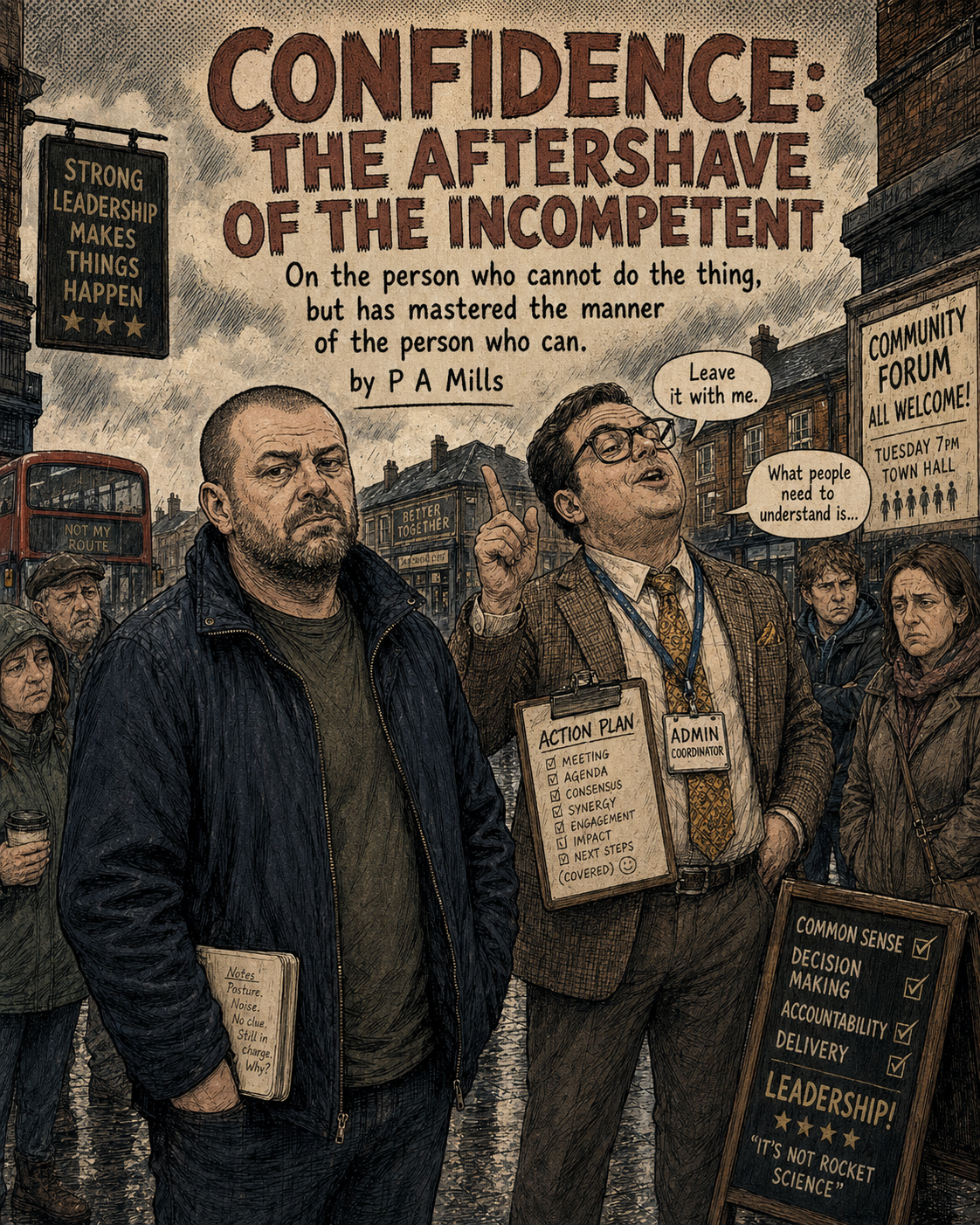
The Aftershave Of Incompetence
On the person who cannot do the thing, but has mastered the manner of the person who can.
by P A Mills
Every room has one.
The man who hears a problem and immediately starts dressing his face for leadership.
He has not listened.
He has not understood.
He has simply recognised a gap in the air where authority might go, and stepped into it wearing the expression of a divorced headmaster.
You know the expression.
Grave.
Firm.
Slightly disappointed in everyone.
The face of a man about to explain something he has only just heard about to people who have been dealing with it for years.
This is the modern authority-cosplayer.
He does not know more than you.
He is just less embarrassed by knowing less.
That is his gift.
Not knowledge.
Not judgement.
Not skill.
Shameless forward motion.
He moves through uncertainty like a shopping trolley with one broken wheel and complete faith in its own direction.
And people let him.
That is the strange part.
A room can contain three careful people, one trained person, two people with direct experience, and one loud bastard with a forehead full of slogans, and somehow the loud bastard gets the floor because he has the confidence of a man who once assembled a barbecue incorrectly and now considers himself practically Roman.
He leans forward.
He narrows his eyes.
He says, “Right.”
And there it is.
The birth of trouble.
“Right” is a dangerous word in the wrong mouth. It suggests order. Clarity. Arrival. It suggests the speaker has gathered the facts, inspected the risks, weighed the options, and returned from the mountain with something worth chiselling into stone.
Often he has done none of this.
Often he has simply become uncomfortable with silence and decided to attack it.
That is what false confidence is.
Not courage.
An assault on silence.
The competent person can pause. The competent person can ask. The competent person can say, “I need to check that.”
A beautiful sentence.
Dull, perhaps.
Not one for the film trailer.
But useful. Adult. Civilised.
The authority-cosplayer cannot say it.
To say “I need to check” would be to admit the room is larger than his ego. So he fills the space instead.
With certainty.
With posture.
With phrases.
“Let’s be clear.”
“Common sense.”
“End of the day.”
“What people need to understand is…”
Lovely.
There are few sentences more alarming than a person saying, “What people need to understand is…” when he himself has understood almost none of it.
But he has the manner.
That is the trick.
He has learned the body language of the capable. The folded arms. The slow nod. The sigh before speaking. The little head tilt of manufactured patience. He knows how to repeat the last three words of a question as if considering them deeply, when in reality he is buying time in a burning shop.
This is not thought.
It is theatre.
And not even good theatre.
More village hall Caesar in a fleece.
The real danger is that many people mistake this performance for competence. They are tired. They are uncertain. They want the discomfort to end. Then someone walks in smelling faintly of aftershave and command, and the room thinks: Thank God. An adult.
No.
Sometimes it is not an adult.
Sometimes it is the room’s panic wearing a belt.
Confidence, when earned, has weight. It is quiet. It does not need to keep clearing its throat. It can survive questions because it has foundations.
False confidence is different.
It is sprayed on.
It enters before the person and lingers after the mistake.
That is why confidence is the aftershave of the incompetent: sharp, artificial, aggressively present, and usually covering something that should have been washed properly.
You see it everywhere.
In workplaces.
In families.
In pubs.
In comment sections.
In committees.
In local groups where someone becomes admin and immediately starts behaving as if the Magna Carta was drafted in their Notes app.
There is a particular kind of person who joins a social group, survives two meetings, learns the word “process,” and begins speaking like a minor colonial governor.
Give him access to a shared calendar and he begins to hear drums.
They love a title.
Chair.
Admin.
Founder.
Coordinator.
Lead.
Community voice.
All fine words in careful hands. But in theirs, each becomes a tiny crown. A little plastic monarchy. A title lands on certain people like a wasp in a pint: suddenly the whole table is involved.
They do not serve the group.
They mount it.
The noticeboard becomes a throne.
The WhatsApp group becomes a ministry.
The laminated badge becomes a personality.
And from that height they begin issuing remarks.
“Can we just keep this respectful?”
Meaning: agree with me more quietly.
“Let’s not make this political.”
Meaning: my politics are already installed as wallpaper.
“I think we need strong leadership here.”
Meaning: I have seen my reflection in a window and believe history has called.
These people do not organise communities.
They develop territories.
A useful person asks, “What needs doing?”
The authority-cosplayer asks, “How should I sound while appearing necessary?”
That is the difference.
He does not want the work.
He wants the outline of a man doing the work.
He wants the room to turn towards him. He wants that tiny social click when uncertainty looks for a parent. He wants to say, “Leave it with me,” and feel the old animal relief of being mistaken for capable.
“Leave it with me” is not a sentence.
It is a smoke alarm in words.
It is what a person says just before a simple problem develops witnesses.
Because what follows is rarely solution.
What follows is motion.
Emails.
Voice notes.
Side conversations.
A little urgent walking.
Perhaps a clipboard.
Perhaps a meeting about the meeting.
Perhaps the phrase “moving forward,” which is often what people say when they have ruined the present.
And when the thing collapses, as it often does, the authority-cosplayer performs the ancient retreat.
“That’s not what I meant.”
“You’ve taken it the wrong way.”
“I was only trying to help.”
“I’m not an expert.”
No.
But five minutes ago you were wearing the voice of one.
That is the insult.
Not ignorance.
Ignorance can be honest. Ignorance can stand at the door and say, “This is not my field.” There is dignity in that. There is even charm.
The insult is the costume.
The borrowed authority.
The counterfeit certainty.
The man who does not know, but knows how knowing is supposed to look.
And society keeps falling for it because we are over-impressed by decisiveness. We like people who sound finished. A careful answer feels weak beside a blunt one. A qualified answer sounds evasive because it contains limits. The expert says, “It depends,” and the fool says, “It’s obvious.”
The fool wins the first ten seconds.
The expert wins the autopsy.
“Obviously” is one of his favourite words.
Obviously we need to act.
Obviously that won’t work.
Obviously they’re lying.
Obviously you’re making it complicated.
Obviously.
A word used by people who cannot afford “possibly.”
Then comes “common sense.”
Another little fraud in a clean shirt.
Common sense, in the mouth of the authority-cosplayer, usually means: I have reached the edge of my knowledge and would now like my instinct promoted without interview.
No evidence.
No method.
No responsibility.
Just “common sense,” laid on the table like a dead pheasant, waiting for applause.
And if someone asks a calm question — “How do you know that?” — the room changes.
The face tightens.
The aftershave sours.
Suddenly the careful person is negative. Difficult. Pedantic. Aggressive. Overthinking it.
This is how fragile false authority is.
It does not answer the question.
It prosecutes the questioner.
Because a real idea can survive inspection.
A borrowed posture cannot.
Tap it once and the hollow part speaks.
That sound is embarrassing.
So he raises his voice.
He speaks again.
Louder this time.
Because to the empty room, silence sounds like death.
And that, finally, is the creature under examination.
Not the fool.
The fool has been with us forever. He is practically heritage.
This is the fool who has studied the manner of the wise. The fool with presentation skills. The fool who has learned that if he stands upright, speaks firmly, and never looks ashamed, the world may grant him ten dangerous minutes before checking the foundations.
Ten minutes is enough.
Enough to steer the meeting.
Enough to poison the mood.
Enough to complicate the simple.
Enough to make the competent arrive later with facts, tools, paperwork, and the expression of people cleaning up after a motivational speaker in a gas leak.
So here he comes.
Freshly sprayed.
Chin up.
Voice steady.
Wrong as thunder.
He has no map.
No method.
No humility.
No relationship with the problem beyond the belief that it should make him look useful.
But he has confidence.
And in the modern world, that will get you halfway to power before anyone asks whether you can spell consequence.