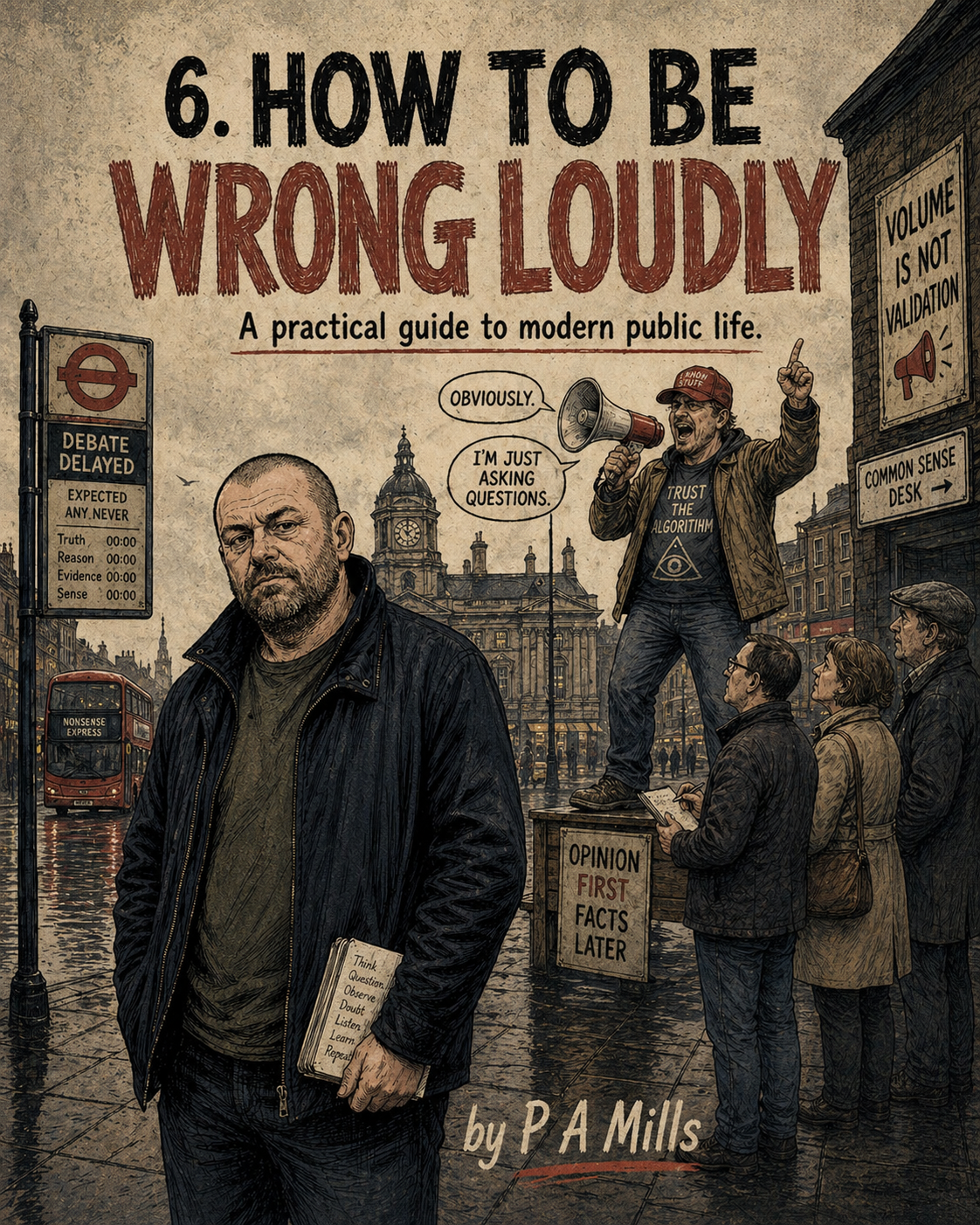
How To Be Wrong Loudly
How to Be Wrong Loudly
A practical guide to modern public life.
by P A Mills
Being right is difficult.
There is reading involved.
Listening, occasionally.
Sometimes one must compare sources, check context, define terms, and endure the small personal funeral of discovering one has been talking absolute bollocks.
Naturally, this has become unpopular.
Modern public life has little patience for such Victorian hobbies. The world moves quickly now. Opinions must be produced at speed, preferably before fact has put its pint down and thrown a punch.
To be right requires evidence.
To be wrong loudly requires only acoustics.
Already, you can see the advantage.
This is not a guide for the honestly ignorant. Honest ignorance has dignity. It says, “I don’t know.” It may even sit quietly, which in the current climate qualifies as public service.
No.
This is a guide for the proudly unteachable.
The person who has never allowed knowledge to interfere with certainty.
The person who can walk into any discussion — medicine, politics, policing, schools, immigration, housing, climate, war, dog behaviour, the council, or why the bus times changed — and within seven seconds become the loudest person in the room.
Not the best informed.
Not the most useful.
The loudest.
A subtle distinction, now apparently lost to civilisation.
Rule one: being wrong loudly is easier than being right
The person trying to be right has problems.
Facts.
Limits.
Context.
Other people.
The possibility that reality may contain more than one moving part.
Awful conditions.
The loud wrong person has none of these burdens. He is free. Free from doubt. Free from correction. Free from that terrible little pause where thought might enter and start asking for documents.
He does not need to understand the subject.
He only needs to arrive with momentum.
And momentum is persuasive to tired people.
A man can be entirely wrong, but if he is wrong with enough forward motion, several adults will begin to mistake him for leadership.
This is one of the more depressing facts about our species, and we invented both libraries and personalised number plates, so the field is competitive.
Rule two: arrive early and never pause
The informed person is at a disadvantage because they are still checking things.
They are reading the actual message.
They are asking what happened.
They are considering whether the first version was incomplete.
The loud wrong person is free from such delay.
He is already speaking.
He enters the conversation like a shopping trolley down a hill: no steering, terrible noise, absolute commitment.
And people notice commitment.
Not quality.
Commitment.
So arrive early.
Speak before the thoughtful have cleared their throats.
Speak before the expert has found the polite way to explain why everyone is already doomed.
Above all, never pause.
A pause suggests thought.
Thought suggests doubt.
Doubt suggests weakness.
And weakness, in modern public discussion, is what happens just before a man called Dave begins explaining international law through petrol prices.
If someone asks for evidence, keep moving.
If someone introduces a fact, talk over the final syllable.
If someone says, “Actually, it’s more complicated than that,” laugh slightly and say:
“There we go.”
There we go is a beautiful phrase.
It means nothing.
That is why it works everywhere.
“There we go.”
The sound of a man placing a traffic cone over a hole in his argument.
Rule three: say “common sense” and “obvious”
Common sense is the magic dust of the loud wrong.
It gives any half-cooked opinion the smell of old wood, village halls, and men who can fix gates.
In practice, “common sense” often means:
I have not read anything, but I have feelings with spikes attached.
This is not a weakness.
This is branding.
Facts are fussy. Facts arrive with footnotes, conditions, dates, margins, and annoying little qualifications. Common sense arrives in a fleece, points at something, and says:
“Well, it’s obvious, innit?”
Obvious is another excellent word.
If something is obvious, you never have to prove it.
Proof is for people who have already lost the room by respecting it.
“Obviously they’re lying.”
“Obviously it’s all connected.”
“Obviously you can’t say anything anymore.”
“Obviously this country’s gone mad.”
The more obvious a thing is to you, the less contact it usually requires with evidence.
Very convenient.
Rule four: treat nuance and definitions as traps
Nuance is dangerous because it slows the stampede.
The thoughtful person says, “It depends.”
The loud wrong person says, “No, it doesn’t.”
And the room, being tired and spiritually underfed, often prefers the second person.
“It depends” is adult language. It admits that reality contains conditions, limits, exceptions, histories, pressures, consequences, and other irritating furniture.
Nobody wants that.
People want a sentence they can carry home in one hand.
This is why slogans work.
A slogan is what happens when complexity has been mugged in an alley and had its shoes stolen.
The intelligent person sees a web.
The idiot sees a straight line because he has missed the furniture.
Definitions are worse.
Definitions are traps set by people who read.
Keep your words large, vague, and emotionally useful.
Freedom.
Truth.
Respect.
Agenda.
Them.
Especially them.
Them is a magnificent word. You can pour anything into it: politicians, doctors, teachers, journalists, scientists, council workers, foreigners, teenagers, vegans, people who reverse badly at Tesco.
Them gives shape to fear without the burden of accuracy.
If anyone asks, “Who exactly do you mean by they?” react as if you have been assaulted by grammar.
A vague enemy is much more useful than a real one.
A real enemy may turn out to be complicated.
A vague enemy can be made to fit the mood.
Rule five: turn correction into persecution
At some point, despite your best efforts, someone may correct you.
They may say, “That is not true.”
They may say, “That article is from 2016.”
They may say, “That image is from another country.”
They may even provide a source, which is vulgar and should not be encouraged.
Do not answer the correction.
Elevate the situation.
You are not wrong.
You are being silenced.
You are not mistaken.
You are being attacked.
You are not spreading nonsense.
You are asking questions.
This is one of the great phrases of the age.
“I’m just asking questions.”
No, you’re not.
You are leaving little bags of suspicion around the room and refusing to pick them up when they start leaking.
A question wants an answer.
A loud wrong question wants an audience.
There is a difference.
The useful thing about claiming persecution is that it converts embarrassment into status.
You were not corrected.
You were oppressed.
You did not misunderstand the subject.
You became too dangerous to the system.
Wonderful.
Five minutes ago, you thought NATO was a Scotsman with a foot abnormality.
Now you are a dissident.
Rule six: increase volume until the room surrenders
Volume has primitive authority.
It reaches something old and damp in the human animal. The part that once heard thunder and thought:
Well, that sounds important.
The loud wrong person understands this.
If an argument is weak, inflate it.
Like a paddling pool.
Or a politician.
Raise the voice.
Lean forward.
Repeat yourself.
Say, “Listen.”
Do not listen.
Listening is how they get you.
The clever person may know more, but the loud wrong person has stamina.
A fool does not need to win the argument. He only needs to make the room too tired to continue.
Not persuasion.
Attrition.
A siege conducted by a man who once got confused by changing bus times and now believes the education system has failed because nobody explained the app to him personally.
He will outlast you.
Not because he is right.
Because he is powered by grievance, and grievance has excellent battery life.
Rule seven: never learn
Learning is fatal to the loud wrong.
Once you learn, you begin to hesitate.
Once you hesitate, you begin to notice.
Once you notice, you may have to adjust.
And once you adjust, your whole public personality begins to wobble like a wardrobe on carpet.
No.
Better not.
Better to remain pure.
The wrong person can remain wrong forever if they protect themselves from information with sufficient discipline.
This is why the loud wrong are so difficult to embarrass. Embarrassment requires contact between self-image and evidence.
They have cut the wires.
And while the intelligent person is still checking whether the question is fair, the loud wrong person has already answered it, misquoted it, blamed the council, and started a group chat called Truth Warriors UK Official.
You have to admire it.
In the way one admires a wasp entering a bus.
Not because it is right.
Because everyone is now dealing with it.
That is the tragedy.
Modern public life rewards the first voice, the loudest claim, the firmest face, the hottest take, the man with the least hesitation and the most saliva.
The thoughtful hesitate because they can see the problem.
The limits.
The missing information.
The human cost.
The possibility that they might be wrong.
That used to be called intelligence.
Now it is often mistaken for fear.
So the loud wrong inherit the room.
They speak in capitals.
They win by exhaustion.
They turn doubt into shame and certainty into theatre.
They are not brave.
They are not awake.
They are not saying what everyone else is afraid to say.
They are saying what a better mind would have stopped to examine.
No.
A foghorn is loud.
So is a dog with its head in a bin.
Volume is not virtue.
Certainty is not proof.
And being wrong loudly is still being wrong.
Only now everyone has heard you.