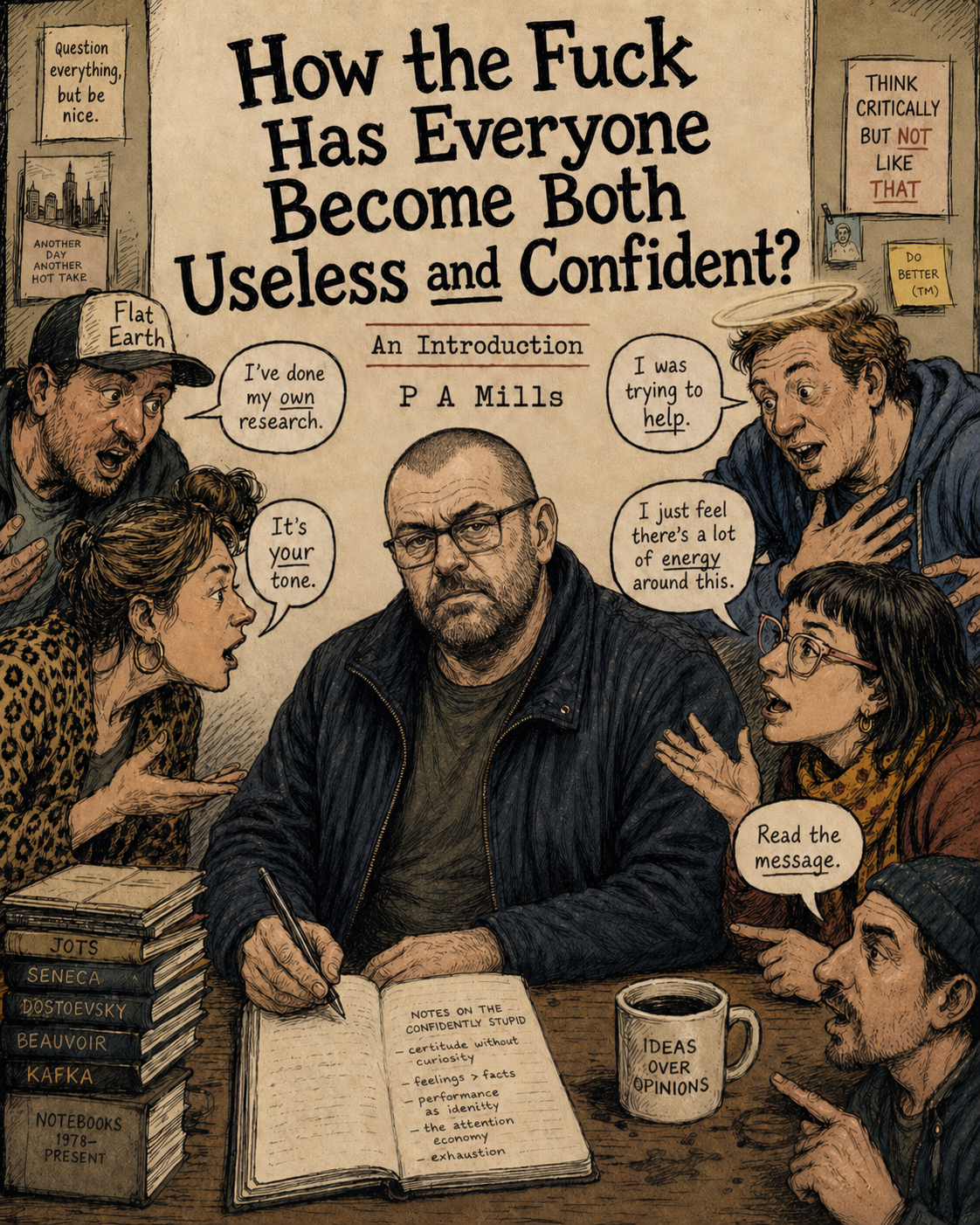
How The Fuck Has Everybody Become both Useless & Confident?
There was a time, perhaps imaginary, when not knowing something produced silence.
A noble age.
A golden age.
A time when a person, confronted with the vast unlit country of their own ignorance, might pause, lower their voice, and think: I do not know enough here to speak.
Now, do not laugh at this, but that was once considered wisdom.
That age is dead.
It did not die heroically. It was not defeated in battle. There was no final stand, no noble collapse, no old philosopher breathing his last beneath an olive tree while muttering something useful about restraint.
No.
It was probably killed in a comments section by a man called Darren who had watched twelve minutes of a documentary and now understood civilisation.
This is the age we have inherited.
A louder civilisation. One in which people know very little, absorb even less, read half a sentence, miss the important part, invent three conclusions, and then enter the room with the confidence of a man who has personally briefed NATO.
And the remarkable thing is not that they are wrong.
People have always been wrong.
Wrongness is one of humanity’s oldest hobbies. It may be our first art form. Before agriculture, medicine, cities, law, literature, or trousers, there was almost certainly some man standing near a river saying, “No, no, I know which berries are safe.”
So the problem is not ignorance.
Ignorance is ancient. Ignorance is loyal. Ignorance has been with us from the beginning.
The problem is that ignorance used to have a little shame.
Old ignorance stood at the back, hat in hand, perhaps embarrassed, perhaps willing to learn. It understood, at some dim animal level, that its chief contribution to the room might be silence.
Modern ignorance has had a rebrand.
It has a ring light. It has a podcast. It has a strong opinion on matters it encountered seven minutes ago while scrolling beside a packet of crisps. It no longer whispers, “I may be out of my depth.” It declares, “I’ve done my own research,” which usually means it has misunderstood a headline, distrusted three experts, and placed its faith in a dude parked in his Uber waiting on his next fare.
This is not merely stupidity.
That would be too generous.
Stupidity, in its natural form, can be almost innocent. It wanders about. It bumps into furniture. It forgets passwords. It buys the wrong size batteries. It looks at a door clearly marked “PULL” and pushes with increasing moral conviction.
But stupidity alone is not the crisis.
The crisis is stupidity with posture.
Stupidity with certainty.
Stupidity that has done a leadership course.
This is the age of confidence without competence.
The age of the half-informed lecture.
The age of the person who cannot follow basic written instructions but feels qualified to explain international conflict, vaccine science, trauma, grief, diet, parenting, mental health, cancer treatment, education, economics, and why your tone is the real problem.
That last one matters.
Because when a person has nothing useful to contribute, they often become deeply interested in tone.
Tone is the refuge of the exposed fool.
It allows a person to ignore the content of what has been said and instead perform a small moral inspection of the way it was delivered. Facts can be inconvenient. Instructions can be clear. Boundaries can be simple. But tone — tone is a misty kingdom where anyone can claim injury and set up a small throne.
Now, do not laugh at this either, but words used to mean things.
A sentence was once expected to carry information from one human mind to another. Crude, perhaps. Imperfect, certainly. But it worked often enough to build bridges, write laws, deliver babies, warn people about cliffs, and occasionally assemble a wardrobe without ending a marriage.
Now, however, language must pass through a committee of feelings before it is allowed to arrive.
One person states a simple limit.
Another person hears accusation.
A third person begins translating tone.
A fourth person explains intention.
A fifth person says they “just feel there’s a lot of energy around this.”
And somewhere beneath the pile of interpretations, the original point lies dead, holding a small sign that said exactly what it meant.
This is where social life becomes theatre.
Not Shakespeare. Not tragedy. Not comedy. Not even one of those strange European plays where a man in a chair represents agriculture.
No.
This is theatre performed by people who have forgotten the script, misunderstood the stage directions, and still somehow believe they should be directing.
It does not read the information provided.
It asks for the information again.
Then, after receiving the information again, it behaves as if the information had been hidden in an ancient temple beneath several riddles and a snake.
This is the modern crisis: not merely that people are useless.
Uselessness, by itself, can be endured.
A useless person who knows they are useless may even become charming. They can make tea. They can hold a door. They can sit quietly in a corner and add no further damage to the atmosphere.
There is dignity in harmless uselessness.
No.
The real danger is the useless person with confidence.
That combination is how shelves are assembled upside down, meetings last ninety minutes longer than their natural lifespan, family situations become hostage negotiations, and one exhausted person ends up explaining the same basic fact twelve times to adults who own cars, mortgages, air fryers, and opinions about geopolitics.
The useless and confident are not always bad people.
That is part of the problem.
Many are kind. Many mean well. Many would describe themselves as “only trying to help,” which is often the phrase people use just before becoming another task.
Because help, in its degraded modern form, no longer means reducing someone’s burden.
It means arriving with your own emotional admin and handing it to the person already on fire.
It means needing reassurance from the person you came to support.
It means confusing proximity with usefulness.
It means mistaking concern for contribution.
It means believing that because you feel something, you have therefore understood something.
And that, perhaps, is the great sickness of the age.
Not feeling.
Feeling is not the enemy.
A human being without feeling is not wise. He is furniture with blood pressure.
The problem is feeling without discipline.
Concern without usefulness.
Opinion without knowledge.
Speech without thought.
Confidence without the burden of evidence.
We have created a culture in which the loudest person is mistaken for the clearest, the most certain for the most informed, the most offended for the most wounded, and the most emotionally expressive for the most morally correct.
This is a problem.
Now, do not laugh at this, but civilisation requires adults.
Not perfect adults.
Not saints.
Not sages.
Not marble-browed Stoics standing on a hill with their robes blowing about, calmly accepting tax codes and lower back pain.
Just adults.
People capable of pausing before speaking.
People capable of reading the whole message.
People capable of understanding that not every boundary is a personal injury, not every correction is an attack, not every silence is oppression, and not every feeling deserves a public inquiry.
The request is modest.
Read the message.
Understand the message.
Respect the message.
Do not turn your confusion into someone else’s workload.
Do not arrive at the edge of another person’s crisis carrying a basket of opinions and no practical use.
And when you do not know, consider the ancient discipline of shutting the fuck up.
There is wisdom in it.
There is mercy in it.
There is, occasionally, the faint possibility that by saying nothing, one might become useful at last.
This series begins there.
Not with hatred of people.
That would be too simple.
Hatred is lazy. It gives the world too much credit. It assumes malice where incompetence has been doing excellent work for years.
No, this begins with observation.
The outsider’s view.
The man at the edge of the room watching the machinery of human behaviour clank, spark, and produce smoke while everyone insists the system is working beautifully.
It begins with the strange modern talent for making everything harder while calling it help.
It begins with the baffling confidence of the badly informed.
It begins with the human creature who listens badly, reads badly, remembers badly, acts badly, then stands among the wreckage asking why everyone is so tense.
This is a study of that condition.
A record of the age in which ignorance became loud, incompetence became performative, and confidence escaped all connection to evidence.
This is not an attack on the stupid.
The stupid have suffered enough.
This is an attack on the stupidly certain.
The people who know nothing, notice little, absorb less, and yet somehow enter every room as if the adults have been waiting for them to explain the weather.
So let us begin with the obvious question.
The question that stands over modern life like a confused man holding the wrong end of a ladder.
How the fuck has everyone become both useless and confident?
⸻