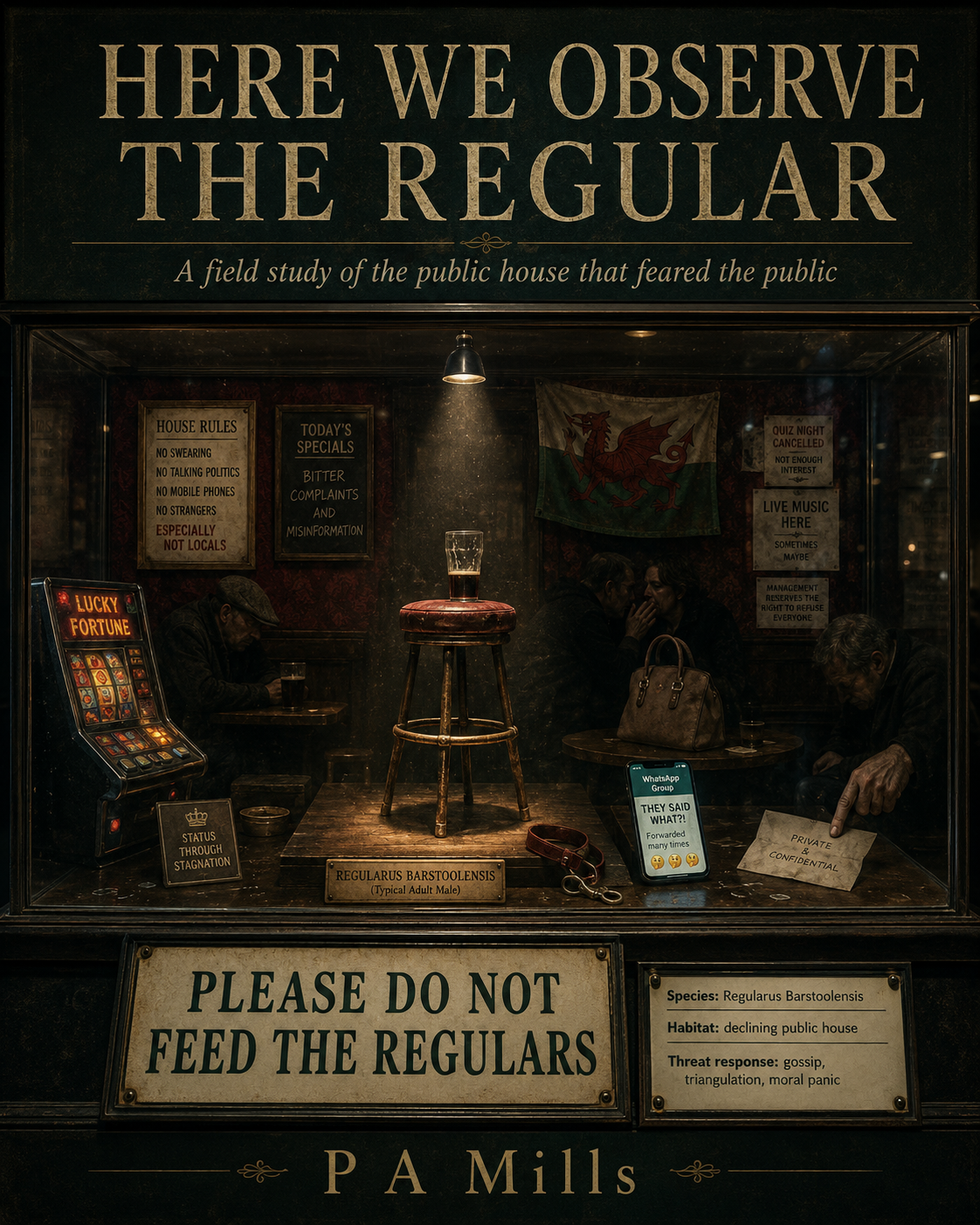
Here We Observe The Regular

A field study of the public house that feared the public
- P A Mills
There are, in the damp corners of certain towns, buildings that still call themselves public houses, though the public has long since sensed danger and made other arrangements.
Approach quietly.
Behind the glass, beneath the tired bunting, the sentimental notices, the sticky tables, and the Union flags waved in Wales with the confidence of people who have misunderstood both history and geography, one may observe the Regular.
The Regular is a territorial creature. He returns to the same stool with the migratory instinct of a salmon and the intellectual development of a commemorative ashtray. Through a process not yet understood by science, he begins to believe that sitting somewhere regularly makes him wise.
This is false.
A damp patch may remain in one place for twenty years. Nobody asks it for moral guidance.
The Regular Male is easily identified. He has a pint, a grievance, and the expression of a man waiting for the modern world to apologise. He generally peaks somewhere around Live Aid and spends the following decades treating 1985 not as a year, but as a lost civilisation. He remembers when things were better, by which he usually means when women endured more, young people had fewer options, and difference of mind could still be mocked with the vocabulary of the thick and the cruel: weird, slow, difficult, “retarded” — words used by people who mistake a slur for an argument.
His call is distinctive.
“You can’t say anything these days.”
This is normally said by a man who has been saying everything for forty years without improvement, interruption, or evidence of thought.
Nearby, one may find the Female Regular, a subtler animal. She does not always roar. She curates temperature. A look held half a second too long. A little sigh. A sentence beginning with “I’m only saying,” which in her dialect means, “I am about to say it, enjoy it, deny it, and later present myself as concerned.”
Her gift is not argument.
It is atmosphere.
She can move a room half an inch colder and still be home in time to consider herself kind. She belongs to that ground-level aristocracy common in British life: people with no real altitude, but a deep need to look down. Snobbery without height. Status without achievement. A little court made of gossip, lowered voices, and the tragic belief that cruelty becomes refinement if spoken near a handbag.
This arrangement works perfectly, provided nobody has the audacity to mention the barn full of skeletons she keeps leaving open after the third drink.
Her cruelty is always public.
Her history, naturally, is private.
Together, the Regulars form what appears to be a community. This is misleading. A community is bound by responsibility. This is a parish court without evidence. It has judges, witnesses, sentences, and verdicts, but none of the tedious legal business of facts.
At the centre of the habitat stand the Keepers of the Pub.
The Keepers believe themselves custodians of local life. In truth, they are curators of decline. They confuse loyalty with noise, atmosphere with entitlement, and hospitality with the subtle art of making people feel they have interrupted something.
The staff have mastered passive aggression. The delayed glance. The cold tone. The sigh that wishes to be a policy. Hospitality without hospitality, which is rather like a lifeboat crew resenting the sea.
A public house, in its best form, is one of civilisation’s kinder inventions. Warmth, argument, music, laughter, ordinary mercy, the democratic grace of strangers sharing a room without needing to own it. But when the worst people in the room become the standard by which the room is run, democracy decays into occupation.
The public house becomes frightened of the public.
And then, one day, into this delicate enclosure, someone brings the most dangerous object known to the adult nursery.
Not a weapon.
Not a lawsuit.
Not even a vegan menu.
Feedback.
Actual comments from young people explaining why they do not want to drink there. In commercial language, this is market research. Businesses usually pay for it before ignoring it in a meeting where someone says “moving forward” and a small part of the soul falls off.
The Messenger makes a beginner’s mistake.
He assumes adults want information.
The Keepers and Regulars do not want information. They want reassurance. They want to be told that the young are wrong: too soft, too poor, too woke, too glued to their phones, too lacking in character to appreciate bad lighting, sticky tables, rude staff, sexual discomfort, and men in their sixties explaining that things were better when nobody challenged them.
The young say otherwise.
The room feels stale.
The staff are rude.
The women are uncomfortable.
The Regulars have become less like customers and more like furniture that makes remarks.
A serious business might listen. A grown-up might say, “Painful, but useful.” A manager with even a passing relationship with reality might ask whether the young have seen something true.
But the adult nursery has built its own little epistemology — a word the Regular may need to look up after he has finished diagnosing the collapse of civilisation from a bar stool. It does not ask, “Is this accurate?” It asks, “Does this flatter us?”
Since the answer is no, the facts must be punished.
Here we observe the first principle of the habitat: when a fragile group cannot tolerate evidence, it does not revise itself. It attacks the witness.
The Messenger has a difference of mind and perception.
He is direct where others prefer implication. He notices patterns where others prefer denial. He seeks clarity where others enjoy the warm swamp of “you know what I mean.” He does not share the local affection for smirk, hint, fog, and retreat. He believes that when people ask a question, an answer is expected.
Among creatures who live by ambiguity, this is practically violence.
His difference should require decency. Instead, it increases their precision. They cannot answer what he has said, so they alter what he is.
Too intense.
Too literal.
Too odd.
Too much.
Mental, apparently.
This is not disagreement. It is pathologising. It is what people do when they have run out of facts but still want the room. They do not refute the criticism. They try to diagnose it.
One must admire the efficiency. A direct person brings evidence. The room declares the evidence a symptom. The critic becomes the condition. The truth becomes proof that the truth-teller is unwell.
This is reputational vandalism, but in the pub dialect it is called “people are talking.”
Then come the embellishments.
This is one of the pub court’s oldest customs. If the evidence embarrasses the room, do not answer the evidence. Change the scenery around it.
A suggestion about the quiz night becomes “trying to take over.”
A comment about the atmosphere becomes “having a problem with everyone.”
A proposed poster becomes “making himself important.”
A complaint about rudeness becomes “being difficult.”
A question about standards becomes “starting drama.”
The facts are never met directly. They are dressed up, dragged through the room, given false eyelashes, lip enhancements, a fake tan, and a lifetime membership to Hulu, then returned as something even the people who were not there feel confident enough to misunderstand.
This is how gossip performs translation. It takes a plain sentence and sends it back looking like it has been raised by reality television and spite.
If the criticism has shape, call it obsession. If the person is clear, call him intense. If he remembers details, call him strange. If he refuses the fog, call him mad.
Philosophers have a name for this.
Bad faith.
Sartre described bad faith as the refusal to face one’s own freedom and responsibility. Here, naturally, it wears pub shoes. The Keepers and Regulars could look at themselves. They could ask why young people avoid them. They could consider whether a young barmaid should have to absorb comments about periods from men old enough to have daughters, mortgages, and a working knowledge of shame.
Instead, they perform innocence.
Some of the males, it should be noted, have daughters. This fact is often produced like a moral passport. “I’ve got daughters.” As if reproduction were a certificate of decency. Yet the same type of man will make a young woman uncomfortable at a bar and call it humour because the alternative is self-knowledge.
Fatherhood does not prevent a man becoming the sort of man his daughter warns her friends about.
The barmaids smile, because employment is theatre.
The Regulars mistake this for charm.
There are other specimens too. One occasionally finds the Amateur Magistrate, a creature with very strong views on discipline, standards, and what is wrong with everybody else. In some cases, the courts themselves may once have suggested that such an animal would benefit from formal exposure to thinking. This is a generous intervention and, one imagines, a challenging day out.
Nearby is the Domestic Philosopher, three marriages deep and no wiser for the excavation. He has mistaken romantic failure for experience, and experience for authority. A man may be divorced three times and still present himself as a guide to civilisation, which is rather like finding three shipwrecks and announcing oneself a harbourmaster.
Around them gathers the chorus: talkers, provokers, estate aristocrats, flag-wavers, self-appointed guardians of standards, and women who can launder malice through concern so cleanly it comes out smelling of fabric softener.
Then comes the private letter.
The Messenger writes privately, because adults are supposed to understand the difference between a dispute and a spectacle. A private letter is communication. It is not a beer mat. It is not a pub quiz handout. It is not a relic to be passed among friends, customers, nodding acquaintances, bored provocateurs, and people who enjoy cruelty more when context has been removed.
But the Keepers share it.
Of course they do.
Small courts need documents. They need exhibits. They need something to hold up while saying, “Look at this,” in the tone of people who have mistaken invasion for evidence. The letter is converted from communication into entertainment.
This is not transparency.
It is triangulation.
Rather than answer the Messenger, they recruit a room.
Not a brave room. Not a principled room. A room of talkers, provocateurs, borrowed opinions, and people whose courage depends entirely on furniture, witnesses, and the possibility of someone else stepping in first. Men who puff themselves up beside a bar. Women who sharpen concern into a blade. Customers who become bold in groups and mysteriously vacant in daylight.
Alone, most of them would fold like wet cardboard.
Alone, they would discover that the person they mocked is not an anecdote, not a diagnosis, not a rumour, not a joke to pass around with a pint, but a human being standing in front of them with a memory.
That is why they need the room.
The room does the work their courage cannot.
This is how local cruelty operates. Rarely by manifesto. Usually by temperature. Neighbours cool. Friends of the Regulars become suddenly informed. People who have not read, heard, asked, or thought somehow acquire a complete moral position. A greeting disappears. A face closes. A silence gets organised.
The family becomes something people discuss rather than people they know.
Then, because small people are rarely satisfied with one target, they widen the theatre.
Children are brought near it.
A wife is made to face it in her workplace.
There is the moral line.
A pub quarrel is one thing. Grown adults unable to survive feedback is another. But when families and workplaces are dragged into the stink of it, comedy gives way to something uglier. This is no longer banter. It is social punishment. Cowardice with witnesses.
And yet, observe the same creatures outside the habitat.
On country lanes, in supermarkets, pitch-side at tacky rugby clubs, outside shops, in the ordinary places where no audience has been arranged, they say nothing. The great talkers become suddenly interested in their dogs. The provocateurs discover the healing power of looking at shelves. The borrowed hard men study the dust near their shoes as though ancient wisdom has been written there.
The women of atmosphere become fascinated by tins, leads, gates, handbags, anything except the human being they helped turn into a local story.
Here lies the strangest reversal.
The person with the difference of mind, supposedly the fragile one, can look directly at them.
They cannot return it.
Without the bar, without the room, without the chorus, without the public forum, without the comfort of numbers, they become what they probably always were: people protecting their dogs, their shopping, and their fragile egos from the dreadful possibility of a single honest exchange.
They do not want confrontation.
They want theatre.
They do not want truth.
They want distance, witnesses, implication, and enough noise to hide the sound of their own cowardice.
Psychologically, none of this is exotic. Projection. Scapegoating. Groupthink. Status anxiety. Defensive aggression. A closed group protects its self-image by locating the problem outside itself. The critic becomes the contaminant. The different person becomes the threat. The family becomes collateral.
Philosophically, it is ressentiment: the resentment of people who cannot bear being measured by a standard they did not invent. Rather than improve themselves, they degrade the thing that judged them.
The young have judged the pub by refusing it.
The Messenger has made the judgement visible.
So he must be reduced.
Too blunt.
Too intense.
Too odd.
Too much.
Mental.
The adult nursery does not grow. It pathologises the person who noticed the smell.
And yet, after all the theory, the funniest part remains the size of the original offence.
A pub wants to know why young people do not drink there.
Young people say why.
A person passes it on.
The pub responds by proving them right.
That is the whole joke. One may dress it in social theory — and sometimes contempt deserves footnotes — but underneath sits the plain creature itself.
A bad pub asks for a mirror and then punches the person holding it.
The Regulars have mistaken occupancy for wisdom. The Keepers have mistaken defensiveness for loyalty. The staff have mistaken rudeness for edge. The men have mistaken women’s politeness for consent. The women have mistaken influence for virtue. The neighbours have mistaken silence for neutrality.
And everyone involved has mistaken a bar stool for a personality.
By the end, the pub has achieved something rare. It has turned free market research into a public autopsy. Every sneer becomes data. Every lie becomes data. Every shared letter becomes data. Every public comment becomes data. Every mockery of difference becomes data. Every passive-aggressive look, every workplace humiliation, every entitled remark to a young woman behind the bar becomes further confirmation of the original complaint.
The young people have not misunderstood the pub.
They have understood it early.
They have recognised a room full of people who cannot be reasoned into the modern age because reasoning would require them to admit that the modern age exists. They have no wish to spend their youth negotiating with fossils over basic manners.
A public house should be a generous room.
But when it becomes a shelter for arrested development, it stops being public in any meaningful sense. It becomes private damage with opening hours. Daycare for grievance. A soft-play area for men and women who cannot regulate disappointment without turning it into a campaign.
And so the field study ends where all such studies must.
Not with justice. That would be too tidy.
Not with repentance. That would require reflection.
Not even with wisdom, because wisdom has long ago tried the door, heard the conversation inside, and gone somewhere else for a quiet pint.
It ends with the pub still wondering why the young do not come in.
Which is a mystery.
A deep one.
Almost impossible to solve.
Except, of course, for the comments explaining it.
But those were brought by the wrong person.
And he was mental, apparently.
So that was that