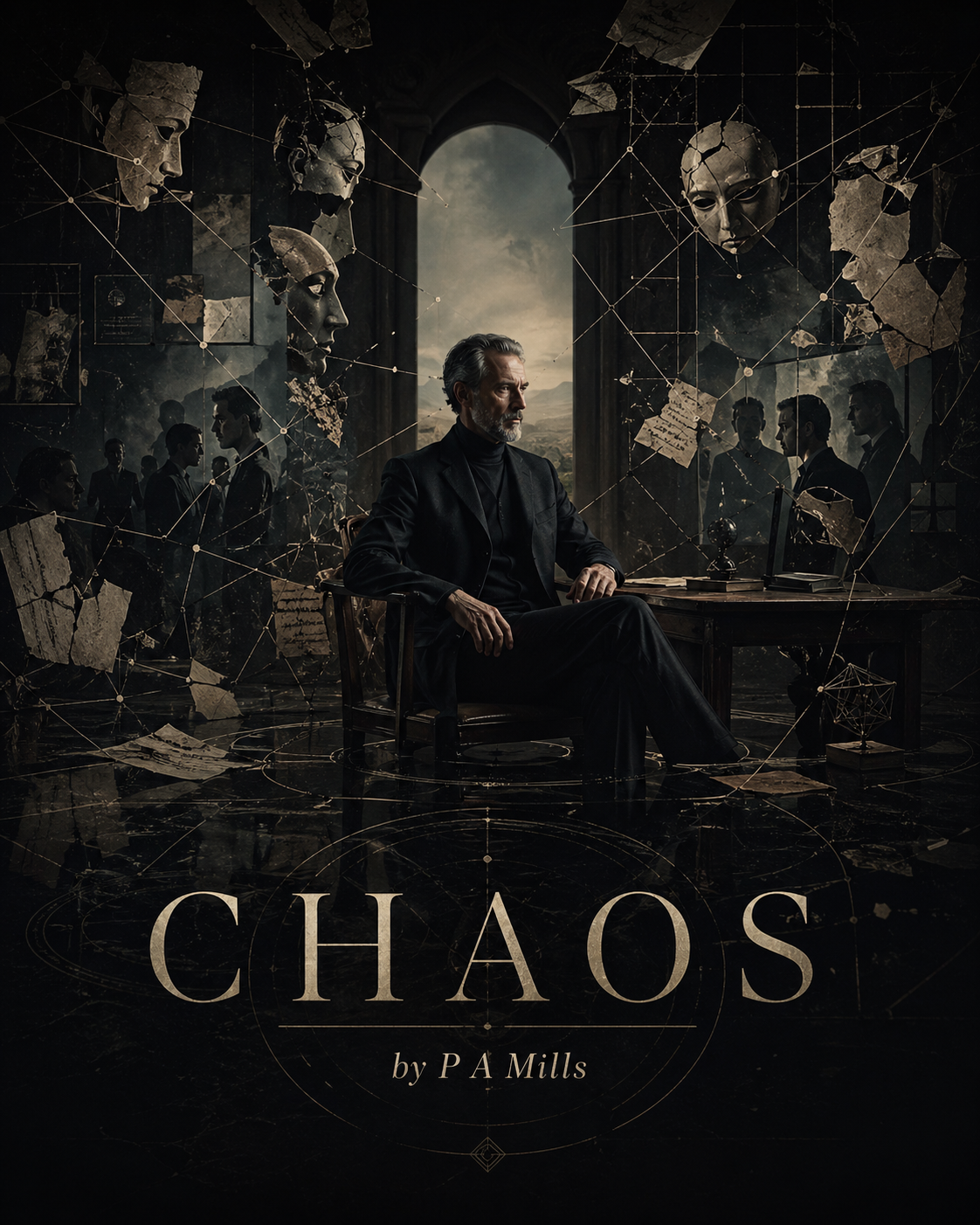
CHAOS
I Am Not Chaos. I Understand It.
I have been called chaos. Many times, by many people. Not as insult, but as conclusion — a label applied by those who encounter something they cannot immediately organise. It is the mind’s reflex when faced with movement it cannot predict: to name it disorder, and in doing so, protect its own sense of stability.
But chaos, as it is commonly understood, is rarely what it appears to be.
The Stoics were precise on this point. Epictetus wrote, “Men are disturbed not by things, but by the views they take of them.” Disorder, then, is not an inherent property of the world, but a reflection of perception — a gap between what is happening and what the mind is capable of understanding. Marcus Aurelius, writing in the midst of war and plague, reinforced this: “You have power over your mind — not outside events.”
This is not passive philosophy. It is operational.
Because if perception defines experience, then chaos is not something to be eliminated — it is something to be seen clearly, and navigated without distortion. Most people cannot do this. There is, however, a quieter shift that underpins all of this — the movement from assuming oneself to be aligned with others, to recognising, with increasing clarity, that one is not. Autism, in this context, has not functioned as a limitation, but as a lens — one that strips back many of the automatic filters that allow people to exist comfortably within shared assumptions.
They rely on continuity — on stable narratives, predictable behaviour, and shared agreements about what reality is supposed to look like. These agreements are maintained through masks: social constructs that preserve identity, reputation, and belonging. The mask is not false, but it is selective. It shows what is acceptable, conceals what is not, and depends entirely on consistency to remain intact.
Under pressure, and scrutiny it fails.
When expectation collapses — through conflict, uncertainty, or threat — the mask fractures. What emerges is not clarity, but fragmentation: contradiction, reaction, emotional volatility. What people call chaos in others is often nothing more than the exposure of their own instability.
I see this. Not as judgement, but as pattern.
Others attempt to define me quickly — to stabilise me through assumption, to place me within a known category so that I can be understood, predicted, and, if necessary, controlled. These definitions are rarely accurate. They are guesses, constructed from limited observation and reinforced through repetition. And when uncertainty persists, people rarely remain independent in their thinking.
They converge.
Narratives are shared. Interpretations are aligned. Gossip becomes a form of consensus-building — not necessarily in pursuit of truth, but in defence of a version of reality that feels coherent. Groups form not because they are certain, but because they are uncertain together. Agreement becomes comfort. Repetition becomes validation.
But in doing so, something is revealed.
Not strength — but dependence.
Because a perception that requires reinforcement is not stable. It is maintained. It is protected. It is, at its core, fragile. While this process unfolds externally, I am engaged in something different.
I study. Patterns of behaviour. Shifts in tone. The precise moment confidence gives way to hesitation. The architecture of the mask — how it is constructed, and where it is most likely to break. This is not instinct alone. It is sustained attention, applied over time, until perception becomes accurate.
The difference is simple:
They guess.
I observe.
This distinction is not new. History repeatedly demonstrates that what is perceived as chaos is often a form of misunderstood strategy. The Vikings, frequently and wrongly reduced to symbols of disorder and brutality, operated with a level of adaptive intelligence that disrupted more rigid societies. Their success was not built on randomness, but on mobility, timing, and the deliberate refusal to conform to expected patterns of engagement.
Contemporary accounts describe their raids as sudden and disorienting — appearing without warning along coastlines and rivers, striking quickly, then dissolving before organised resistance could form. They did not rely on static formations or prolonged confrontation. They created asymmetry.
They did not meet structure.
They broke it.
This is not unique to them. Across history, individuals who function effectively in chaos share a similar relationship with instability. Leaders in crisis, strategists in war, creators in moments of cultural fracture — they do not require certainty to act. They do not wait for clarity to emerge. They operate within ambiguity. They reduce complexity in real time. They move while others hesitate.
This is where I exist.
Not within chaos as identity, but within chaos as environment.
Stoicism provides the internal framework — the discipline of perception, the refusal to be governed by impulse, the ability to remain intact regardless of external conditions. Norse philosophy, by contrast, does not seek to eliminate chaos, but to acknowledge it as fundamental. The world is not stable. It is contested, shifting, often indifferent. Order is temporary. Conflict is inevitable.
To exist within this worldview is not to fear collapse, but to accept it as part of the structure of reality. The combination is precise.
From Stoicism: control of mind.
From Norse thought: acceptance of instability.
Together, they produce something functional:
Clarity within movement.
I do not seek calm as an absolute state. I do not depend on controlled environments to think clearly. When pressure increases, I do not fragment. I narrow. Noise reduces. Signal emerges. Decision becomes possible. And when chaos is directed toward me — whether through conflict, misinterpretation, or deliberate opposition — I do not respond with resistance alone.
I reposition.
Because chaos, when understood, can be redirected.
A system already under strain requires very little to shift further. A narrative built on assumption requires very little to unravel. A group dependent on shared perception requires very little disruption to expose its inconsistencies. This is not aggression. It is awareness applied with intent. To those observing from the outside, this can appear as if I am the source of disorder.
But I am not introducing chaos.
I am revealing its presence.
It exists already — in people, in systems, in the fragile agreements that hold perception together. Most choose not to see it, because to do so would require them to question the stability of their own position within it. I do not have that hesitation. Because I am not dependent on the illusion of order.
Iunderstand it.
And because I understand it,
I can move through it —
without losing form.
P A Mills